Crocus, Cowslip and Primrose: The First Goldens
If you've ever found yourself tracing the lineage of your beloved Golden Retriever, you might have stumbled upon fascinating stories, some true, some fantastical. It's a common frustration to try and separate the well-documented history from the enduring myths that cling to such a popular breed. This guide is here to shed light on the real origin story of our wonderful Goldens, focusing specifically on the very first puppies that started it all: Crocus, Cowslip, and Primrose.
Dispelling the Russian Circus Myth: The True Origin Story
For years, a charming but utterly false tale circulated that Golden Retrievers originated from Russian circus dogs. Imagine, if you will, a troupe of majestic, golden-coated dogs performing incredible feats, then being "rescued" and brought to Scotland to found a new breed. It’s a lovely story, isn't it? It captures the imagination and speaks to the Golden’s natural showmanship. But the reality, while perhaps less dramatic, is far more historically significant and beautifully documented. The truth lies not in a distant circus tent, but in the meticulous records of a passionate Scottish nobleman.
Lord Tweedmouth and the Guisachan Estate
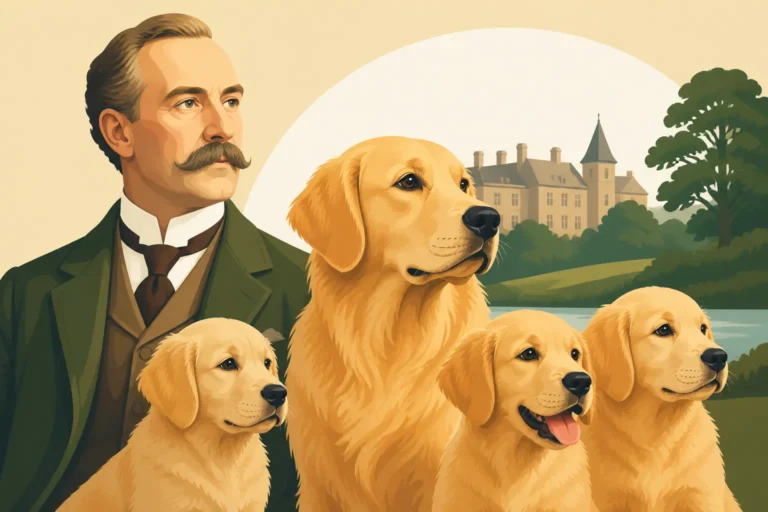
The real story of the Golden Retriever begins firmly with Dudley Coutts Marjoribanks, also known as Lord Tweedmouth, on his sprawling Guisachan Estate in the Scottish Highlands. Lord Tweedmouth was a man with a vision, a true sportsman who wanted to develop a superior retriever for hunting waterfowl and upland game. He wasn't just interested in a pretty face; he needed a dog with an excellent nose, a biddable temperament, and a "soft mouth" to retrieve game without damaging it, all while being able to withstand the often harsh Scottish climate. He understood that to achieve this, he couldn't rely on random pairings; he needed a systematic approach, carefully selecting dogs for specific traits. The idea of these dogs simply appearing from a circus act would have been utterly preposterous to a breeder of his caliber and dedication. He was creating something unique and purposeful. Lord Tweedmouth and the First Golden Retrievers
The Importance of the Stud Book
What truly sets the Golden Retriever's origin apart, and what definitively debunks the circus myth, is Lord Tweedmouth’s fastidious record-keeping. He maintained detailed stud books from 1835 to 1890, documenting every breeding, every puppy, and often specific notes on their temperament and abilities. This wasn't just a casual ledger; it was a comprehensive genealogical record, something quite advanced for its time. These ledgers detailed the exact pairings he made, the breeds involved in his early crosses, and the characteristics he was trying to refine. When this stud book was finally published in 1952, it laid bare the scientific, thoughtful process behind the creation of the Golden Retriever, forever silencing the myths. It showcased his commitment to selective breeding and provided an irrefutable paper trail of the breed’s true beginnings. If you want to know more about this, look up The Stud Book That Proved the Golden's Real Origin.
Nous and Belle: The Foundational Pair
At the heart of Lord Tweedmouth’s breeding program, before the birth of Crocus, Cowslip, and Primrose, were two dogs whose union would change canine history: Nous and Belle. Their story is fundamental to understanding the genetic bedrock of every Golden Retriever alive today. It's a classic tale of two distinct dogs bringing complementary qualities to a new, emerging breed.
Nous, the Yellow Retriever
Nous was Lord Tweedmouth’s prized "yellow retriever," a dog he acquired in Brighton in 1865. Interestingly, at this time, "retriever" was more of a job description than a specific breed, and various colors existed within the retriever types. Nous himself was the offspring of a black Wavy-coated Retriever and a Tweed Water Spaniel. This combination was significant. The Wavy-coated Retriever (an ancestor of today's Flat-Coated Retriever) brought excellent retrieving instincts and a strong working drive, while the Tweed Water Spaniel, a now-extinct breed, contributed a love for water, endurance, and a robust, curly-coated physique. Nous was a striking yellow dog, a color that Lord Tweedmouth particularly admired and sought to perpetuate. His calm demeanor and natural retrieving ability made him an ideal candidate to be a foundational sire. It’s worth noting that the term "Yellow Retriever" was an early descriptor for these types of dogs before "Golden Retriever" became standard. If you're interested in the ancestors, read about The Tweed Water Spaniel Behind Every Golden Retriever.
Belle, the Tweed Water Spaniel
Belle, the other half of this pivotal pairing, was a Tweed Water Spaniel. This breed was known for its intelligence, eagerness to please, and exceptional retrieving skills, particularly in water. They were sturdy, medium-sized dogs with a liver-colored, curly coat, and a strong affinity for waterfowling. Lord Tweedmouth specifically bred Belle because he recognized the invaluable traits she could pass on: a tractable nature, keen intelligence, and superb aquatic retrieving abilities. Her influence cannot be overstated. Belle brought a crucial genetic contribution to the table, ensuring that the nascent Golden Retriever breed would inherit not just the desired coat color, but also the essential working characteristics that Lord Tweedmouth so desperately sought. Her genetic contributions blended perfectly with Nous's, setting the stage for a truly remarkable litter.
The First Recorded Litter: Crocus, Cowslip, and Primrose
The true beginning, the moment the Golden Retriever breed officially stepped from concept to reality, arrived with the birth of Nous and Belle's first litter. This particular group of puppies, born on the Guisachan Estate, holds a special place in history.
The Significance of the 1868 Litter
In 1868, Nous and Belle produced a litter of four yellow puppies. Of these, three females — Crocus, Cowslip, and Primrose — became the very first named and recorded Golden Retrievers. This wasn't just another litter of puppies; this was the culmination of Lord Tweedmouth’s vision. This specific litter proved that his careful selection and cross-breeding could produce offspring with the desired "yellow" coat and, more importantly, the specific combination of intelligence, biddability, and retrieving prowess he was aiming for. They were living proof that a new, distinct type of retriever was emerging. Their birth is considered the true genesis of the Golden Retriever, marking The Year the Golden Retriever Foundation Litter Was Born. Without the careful documentation of this specific litter, the breed's origins might still be shrouded in the Russian circus myth.
Their Role in Shaping the Breed's Early Traits
Crocus, Cowslip, and Primrose, as the first Golden Retriever puppies, were instrumental in solidifying the foundational traits of the breed. They embodied the gentle temperament, the intelligent gaze, and the inherent desire to retrieve that we cherish in Goldens today. Cowslip, in particular, was kept by Lord Tweedmouth and became a significant contributor to subsequent generations. She was repeatedly bred back to various carefully selected males, including another yellow retriever and a red Irish Setter, demonstrating Lord Tweedmouth's ongoing commitment to refining and diversifying the gene pool while retaining the core characteristics. These early Goldens weren't just pretty dogs; they were functional, intelligent working companions, and their progeny continued to pass on these essential characteristics, setting the stage for the beloved breed we know today.
Beyond the First Litter: Expanding the Golden Lineage
Lord Tweedmouth's breeding program didn't stop with Crocus, Cowslip, and Primrose. He continued to selectively breed, always with the goal of improving the working retriever. He understood the importance of a diverse gene pool, even within his carefully curated lines, to prevent inbreeding and introduce new, desirable traits.
Introducing the Black Retriever and Irish Setter Lines
To enhance certain traits and maintain genetic diversity, Lord Tweedmouth carefully introduced other breeds into his burgeoning Golden Retriever line. This included black retrievers (likely more Wavy-coated Retrievers) and red Irish Setters. The black retrievers reinforced the strong retrieving drive and robust build. The Irish Setter crosses were specifically chosen to improve the breed’s scenting abilities and potentially introduce a richer, deeper red hue into the coat, which occasionally appears in today's Goldens as a testament to these early ancestors. He also reportedly used a Bloodhound cross at one point to further enhance scenting ability, a trait still evident in many Goldens today who excel in tracking. These thoughtful outcrosses, always with specific goals in mind, demonstrate the deliberate and sophisticated nature of his breeding program, ensuring a healthy and capable breed. It gives us a better understanding of What Breeds Went Into the First Golden Retrievers.
Establishing the Golden Standard
Through the continued breeding of dogs like Cowslip and the thoughtful integration of other bloodlines, Lord Tweedmouth gradually cemented the characteristics that would define the Golden Retriever. The dogs produced from his Guisachan kennels consistently exhibited a particular type: a medium-sized, powerful dog with a dense, water-repellent coat, a gentle but keen expression, and an unwavering desire to please. Their intelligence, coupled with their innate retrieving drive and calm disposition, made them exceptional gundogs and beloved companions. These traits were so consistent that they eventually formed the basis for the first breed standards, formalizing what Lord Tweedmouth had achieved. These early efforts were the blueprint for what would become The AKC Golden Retriever Breed Standard, a testament to his original vision.
The Legacy of Guisachan's Goldens
The influence of Lord Tweedmouth's work at Guisachan, and specifically the foundation laid by Nous, Belle, and their progeny like Crocus, Cowslip, and Primrose, extends far beyond the Scottish Highlands. It's a legacy that has touched millions of lives globally.
From Private Estate to Public Recognition
Initially, the Golden Retriever was a breed primarily known and appreciated within a close circle of British gentry and sportsmen. However, the undeniable qualities of these dogs—their beauty, intelligence, and kind nature—could not be contained within private estates forever. Gradually, Lord Tweedmouth’s descendants and other enthusiasts began to exhibit and sell the dogs more widely. By the early 20th century, the breed gained official recognition. The Kennel Club of England recognized the "Yellow or Golden Retriever" as a distinct breed in 1913, and eventually, the American Kennel Club (AKC) followed suit in 1925, solidifying its place in canine history. This journey from a private breeding project to international recognition is a fascinating chapter in the breed's story. If you're curious about this timeline, you might want to read about When the AKC Recognized the Golden Retriever.
The Enduring Impact on Today's Golden Retrievers
Every Golden Retriever you see today, whether a playful puppy or a distinguished senior, carries a piece of Nous, Belle, Crocus, Cowslip, and Primrose within their genetic makeup. The soft mouth that allows them to gently carry anything from a retrieved duck to a child's toy, their intuitive understanding of human emotion, and their boundless enthusiasm for life are all echoes of Lord Tweedmouth’s original vision. Their genetic legacy underpins the different lines we see today, from the lithe, athletic Field, Show and English Cream Golden Retrievers bred for performance, to the stockier, more heavily coated show lines, all maintaining that quintessential Golden temperament. Understanding their origins deepens our appreciation for the breed's incredible history and the thoughtful dedication of its founder. It's a powerful reminder that every wagging tail and loving gaze has a story stretching back to those first golden puppies in Scotland.
| Origin Aspect | Mythical Russian Circus Origin | Documented Guisachan Origin |
|---|---|---|
| Founder | Unknown "rescuer" or mysterious circus owner | Lord Tweedmouth (Dudley Coutts Marjoribanks) |
| Location | Russian circus, then Scotland | Guisachan Estate, Scottish Highlands |
| Foundation Stock | A troupe of performing circus dogs | Nous (Yellow Retriever) & Belle (Tweed Water Spaniel) |
| Key Progeny | Unspecified | Crocus, Cowslip, Primrose |
| Evidence | Anecdotal stories, oral tradition | Detailed stud books and historical records |
| Purpose | Preservation of unique circus dogs | Creation of a superior retrieving gundog |
Disclaimer
This article is for general informational purposes only and does not constitute professional advice. Laws, prices and regulations vary by location and change over time. Consult a qualified professional for guidance on your specific situation.