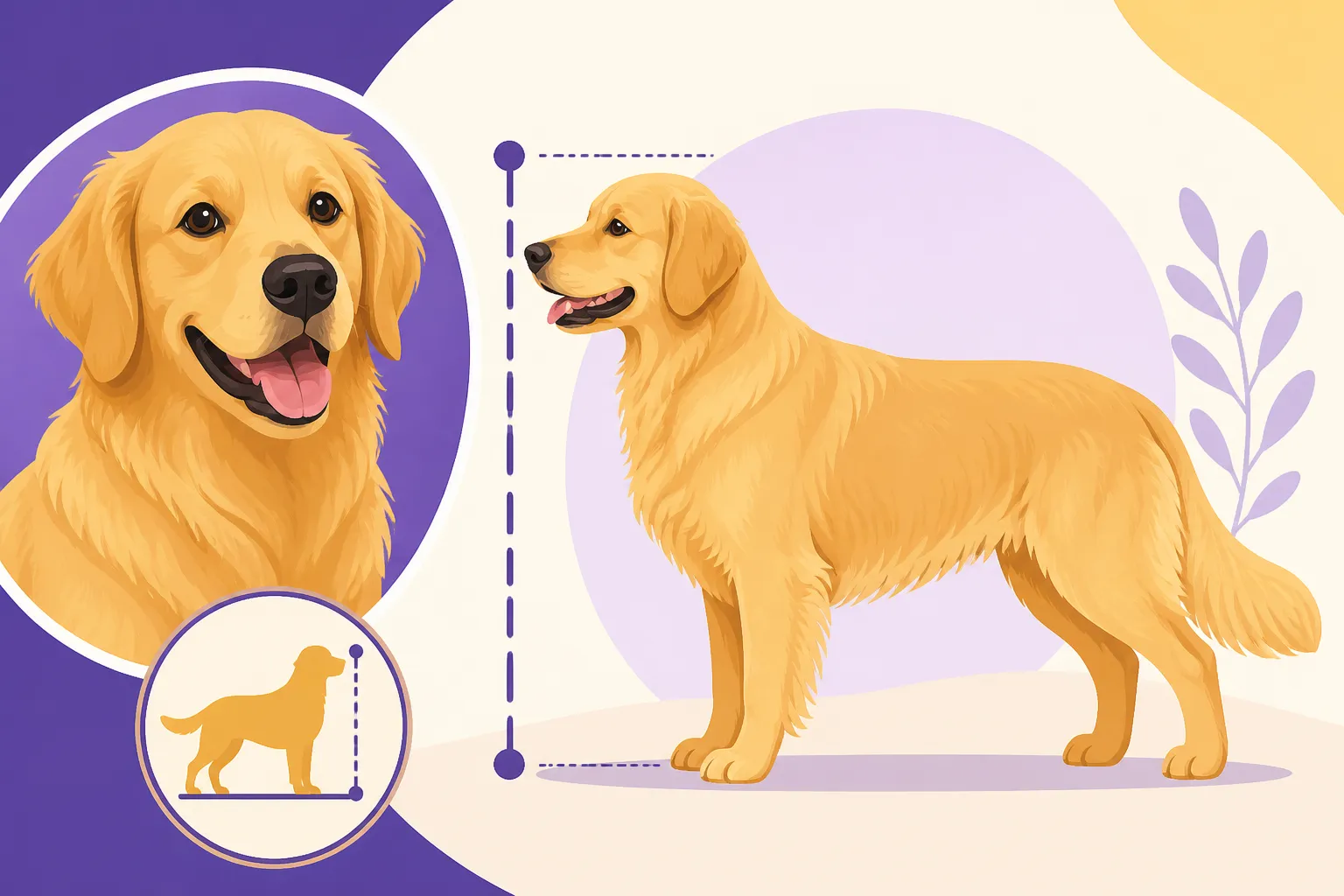
Ideal Height for a Female Golden Retriever
It can feel a little overwhelming when you start looking into specific details about Golden Retrievers, especially when you encounter all the official lingo like "breed standards." You might be wondering if your sweet girl, who perhaps seems a bit smaller or larger than her counterparts at the dog park, truly measures up. This guide is here to cut through the confusion and explain exactly what the ideal height for a female Golden Retriever is, why it matters, and what factors can influence your dog's size.
Understanding the Golden Retriever Breed Standard for Height
When breeders and enthusiasts talk about an "ideal" height, they're typically referring to the breed standard set by organizations like the American Kennel Club (AKC). This standard isn't just arbitrary; it's a detailed blueprint describing the perfect Golden Retriever, from nose to tail, including their physical dimensions, temperament, and movement. It exists to maintain the breed's integrity, health, and ability to perform the tasks they were originally bred for. For pet owners, while not something to obsess over, understanding these guidelines can offer valuable insights into your dog's lineage and potential characteristics.
What Constitutes the Official Breed Standard for Females
The AKC provides very specific measurements for Golden Retrievers, distinguishing between males and females. For a mature female Golden Retriever, the ideal height, measured from the highest point of the shoulder blades (the withers) to the ground, is generally considered to be between 21.5 and 22.5 inches. This isn't a hard-and-fast rule that dictates whether your dog is "good enough," but rather a benchmark for breeders aiming to produce Goldens that conform to the historical and functional ideals of the breed. It also offers a guide for what a healthy, well-proportioned Golden should look like. You can delve deeper into The AKC Golden Retriever Breed Standard to see all the different aspects breeders strive for.
It's important to remember that this standard is for adult dogs. A puppy will obviously be much smaller, and their growth rates can vary. Don't panic if your six-month-old girl isn't hitting these numbers yet; she still has a lot of growing to do. Most Golden Retrievers will reach their full height around 12-18 months, though they may continue to fill out in weight and muscle mass until they're two or even three years old.
Why Breed Standard Deviations Occur
You might have met Golden Retrievers who are noticeably taller or shorter than this ideal range. There are several reasons why these deviations occur, and most of them are perfectly normal for a beloved family pet. First and foremost is genetics. Not every breeding produces offspring that perfectly match the standard, even with the most careful planning. A breeder might have a perfectly healthy female whose parents were slightly outside the standard, and she inherits those traits. Also, there are different lines within the Golden Retriever breed, such as field lines and show lines. Field line Goldens are often bred for agility and working ability, and may sometimes be a bit leaner and even slightly smaller or larger than their show line counterparts, which are bred more strictly for conformation to the breed standard.
Another significant factor is nutrition during critical growth phases. Both underfeeding and, perhaps more commonly, overfeeding a puppy can impact their final size and skeletal development. Giving a rapidly growing puppy too many calories can lead to excessively fast growth, which can put undue stress on their developing joints and potentially lead to issues like hip and elbow dysplasia later in life. This is why specialized large breed puppy foods are so often recommended by veterinarians, as they are formulated to promote slower, steadier growth. Factors like the timing of spaying or neutering can also play a role, as hormones influence bone plate closure. Spaying and Neutering Timing for Goldens is a topic many new owners grapple with, and it's worth understanding its potential impact on growth.
Accurately Measuring Your Female Golden Retriever
Knowing the standard is one thing, but actually measuring your dog can be a little tricky if you've never done it before. It’s not like measuring a child where you just stand them against a wall. Dogs, especially Goldens, are wiggly bundles of joy, and getting them to stand still and square can be a challenge! However, with a little patience and the right technique, you can get a reasonably accurate measurement to compare against the breed standard.
The Correct Way to Measure from the Withers
To measure your Golden Retriever's height, you need to measure from the ground to the top of her withers. The withers are the highest point on her shoulder blades, typically where her neck meets her back. It's crucial not to measure to the top of her head, as that can vary greatly depending on how she's holding her head, and it's not the anatomical point used in breed standards.
Here's how to do it:
- Position Your Dog: Have your Golden stand squarely on a flat, level surface. Her front legs should be straight, and her back should be level, not sloped up or down. This might require a friend to help keep her still and distracted with a treat or toy. If you're using a treat, something from Chewy she particularly loves might do the trick!
- Identify the Withers: Gently feel for the highest point of her shoulder blades. This area is usually firm and doesn't move much when she shifts her head.
- Use a Measuring Tool: A carpenter's square, a sturdy yardstick, or even a specialized dog measuring stick (called a wicket) works best. Place one end of the square or stick on the ground next to her front leg, perpendicular to the floor. Then, bring the other part of the square down until it's perfectly level with the top of her withers. Read the measurement. If you don't have a square, you can place a level straightedge (like a ruler or thin book) across her withers, parallel to the ground, and mark where it hits a wall. Then measure from the floor to that mark.
- Repeat for Accuracy: Take a few measurements to ensure consistency. Your first attempt might be a bit off, so trying it two or three times and averaging the results can give you a more accurate figure.
When to Measure Your Growing Golden
The best time to measure your female Golden Retriever for her adult height is when she has finished growing. For most Goldens, this is typically around 18 months of age, though some might continue to grow a little taller up to two years old. Prior to this, her growth plates are still open and actively developing. When a Golden Retriever's Growth Plates Close is an interesting topic that explains why waiting is important.
Measuring a puppy might give you a snapshot of her growth, but it won't reflect her mature size. If you're curious about her development, you can track her progress every few months, but don't expect her to hit the adult standard until she's closer to maturity. Early and rapid growth isn't always a good sign; slower, steady growth is generally healthier for large breeds like Golden Retrievers, reducing stress on developing joints. This is a point that reputable breeders and vets often emphasize.
Factors That Influence a Female Golden Retriever's Ultimate Height
It’s easy to look at the breed standard and think every Golden Retriever will fit neatly into that box. But just like people, dogs come in all shapes and sizes, even within the same breed. While the standard gives us an ideal, several factors can influence whether your female Golden reaches the top, bottom, or even slightly outside of that average range. It's fascinating to see how genetics and environment interact to shape our furry friends.
The Role of Genetics and Lineage
The genetic blueprint inherited from her parents and their ancestors is the primary determinant of your Golden's ultimate size. If both her parents were on the taller side of the standard, there's a good chance she will be too. Conversely, if they were smaller, she's likely to follow suit. This is why a good breeder will be transparent about the size of the parent dogs and the broader lineage. They'll also be performing Health Clearances a Golden Retriever Breeder Must Show, which indirectly contribute to a healthy growth trajectory.
As mentioned earlier, there are also discernible differences between different types of Golden Retrievers. American show lines tend to adhere very closely to the AKC standard, often appearing blockier and more substantial. Field lines, on the other hand, are bred for performance and may be slightly leaner, sometimes with less bone, and their heights can show a bit more variation while still being considered true Goldens. Then there's the popular "English Cream" Golden Retriever, which often originates from European lines. These dogs also have their own subtle variations in build and height compared to American lines. Understanding these distinctions helps manage expectations for your dog's final size.
Nutrition and Growth Management
What and how much your Golden Retriever puppy eats during her formative months plays a huge role in her development. Large breed puppies like Goldens have unique nutritional needs. They require a diet that supports steady, controlled growth, rather than rapid weight gain. Overfeeding a puppy, especially with high-calorie foods, can accelerate growth too quickly, which can place excessive strain on their rapidly developing joints and bones. This can predispose them to orthopedic problems later in life, such as hip or elbow dysplasia.
Quality large breed puppy food is formulated with specific calcium-to-phosphorus ratios and controlled calorie levels to ensure optimal, but not too fast, growth. Always follow the feeding guidelines provided by your veterinarian or the dog food manufacturer, adjusting as needed based on your puppy's individual growth and energy level. Checking your puppy’s body condition regularly, rather than just focusing on the number on the scale, is also crucial. You should be able to easily feel her ribs without them being visibly prominent. A good resource from Chewy or your vet can help you select the appropriate food and monitor her growth effectively. How Much to Feed a Golden Retriever Puppy offers a more detailed look at this important aspect of puppy care.
The Impact of Spaying or Neutering Timing
The timing of spaying or neutering can also influence a Golden Retriever's mature height, particularly in relation to bone growth plate closure. Hormones, specifically estrogen and testosterone, play a role in signaling the growth plates in long bones to close. If a dog is spayed (females) or neutered (males) before their growth plates naturally close, they may grow slightly taller than their intact counterparts. This is because the absence of these hormones can delay the closure of the growth plates, allowing the long bones to continue growing for a longer period.
While the difference might not be dramatic, it can lead to a dog that is slightly leggy or taller than the breed standard. This isn't necessarily a bad thing for a family pet, but it's a factor to consider when discussing the ideal height. Many veterinarians now recommend waiting until a Golden Retriever is at least 18-24 months old to spay or neuter, allowing their skeletal system to fully mature. This approach aims to reduce the risk of certain orthopedic issues, though the research on this topic is ongoing and complex.
Implications of Height Deviations in Female Goldens
So, what happens if your female Golden Retriever doesn't fall squarely within that 21.5-22.5 inch range? For most pet owners, it's really not a big deal. The breed standard is primarily for conformation showing and breeding purposes. However, for those interested in the intricacies of the breed, or for breeders, understanding these implications can be quite important.
Health Considerations for Undersized or Oversized Goldens
While slight deviations are common and generally harmless, significant departures from the ideal height can sometimes be linked to health considerations. For example, an excessively large Golden Retriever might be more prone to joint issues simply due to the increased weight and stress on their skeletal system. Golden Retriever Weight and Joint Damage is a very real concern for many owners. Conversely, an unusually small Golden Retriever, if not simply a natural variation, might indicate a slower growth rate due to underlying health issues or nutritional deficiencies in puppyhood.
It's also worth noting that rapid growth, often linked to overfeeding in puppyhood, can exacerbate predispositions to orthopedic conditions. Ensuring your puppy grows at a healthy, moderate pace is far more important than trying to push her to reach a certain size. Your vet is the best resource for monitoring your Golden's growth and ensuring she is developing healthily, regardless of whether she hits the exact middle of the breed standard.
Conformation Show Ring Disqualifications
For breeders and owners involved in the competitive conformation show ring, adhering to the breed standard is paramount. In this context, height deviations are not just preferences but can lead to disqualification. The AKC breed standard for Golden Retrievers specifically states disqualifications for height: "Dogs more than 24 inches or less than 23 inches in height at the withers shall be disqualified. Bitches more than 22.5 inches or less than 21.5 inches in height at the withers shall be disqualified."
This means that if a female Golden Retriever measures even a quarter-inch outside of the 21.5-22.5 inch range, she cannot win in an AKC conformation event. This strictness underscores the importance breeders place on careful selection and breeding programs aimed at producing dogs that embody the breed's physical ideal. For pet owners, this simply highlights why breeders pay such close attention to these measurements and may occasionally mention their dogs' exact heights.
Everyday Life and Your Beloved Pet
For the vast majority of Golden Retriever owners, whether your female is 21 inches or 23 inches tall, it makes absolutely no difference to her quality of life, her wonderful temperament, or the joy she brings to your home. A Golden Retriever's heart of gold, her retrieving instincts, and her unwavering loyalty are far more important traits than a precise measurement at the withers.
Your Golden will still want to retrieve toys (perhaps with some from Chewy), go for walks, and cuddle on the couch, regardless of whether she fits the ideal height of Golden Retriever Size and Adult Proportions. The most important thing is that she is healthy, well-socialized, and loved. If you have concerns about your dog's size or growth, especially if she seems to be growing too fast, too slowly, or appears disproportionate, always consult with your veterinarian. They can assess her overall health and give you personalized advice.
Comparison of Male vs. Female Golden Retriever Height Standards
| Characteristic | Male Golden Retriever | Female Golden Retriever |
|---|---|---|
| Ideal Height | 23-24 inches at withers | 21.5-22.5 inches at withers |
| Weight Range | 65-75 pounds | 55-65 pounds |
| Bone Structure | Generally heavier bone | Generally lighter bone |
| Disqualification | < 23" or > 24" | < 21.5" or > 22.5" |
Disclaimer
This article is for general informational purposes only and does not constitute professional advice. Laws, prices and regulations vary by location and change over time. Consult a qualified professional for guidance on your specific situation.