When Lord Tweedmouth Started Breeding Golden Retrievers
Many Golden Retriever owners, myself included, have wondered about the true origins of our beloved companions. There's so much folklore out there, and it can be genuinely frustrating trying to sift through it all to understand where this incredible breed really came from. If you’ve ever heard tales of Russian circus dogs or just felt confused about the timeline, this guide is for you. We’re going to dive deep into the real story, focusing on the remarkable individual who meticulously created the Golden Retriever breed and precisely when his groundbreaking work began.
The Myth and the Reality: Dispelling Early Misconceptions
Before we get to the fascinating truth of the Golden Retriever's origins, it’s worth taking a moment to address a rather persistent myth that has circulated for generations. You might have even heard it yourself at a dog park or from a well-meaning acquaintance. This isn't just a bit of trivia; understanding the real history is crucial to appreciating the intentionality and dedication that went into creating the breed we adore today.
The Persistent Russian Circus Dog Tale
For a long time, an intriguing but entirely false story held sway: the idea that Golden Retrievers descended from Russian circus dogs. The tale often involved a wealthy Englishman (sometimes identified as Lord Tweedmouth himself) attending a circus, being captivated by a troupe of performing Russian sheepdogs, and then purchasing them to start his breeding program. It’s quite a romantic image, isn’t it? Fluffy, intelligent dogs performing tricks, then whisked away to become the foundation of a new, noble breed. The story was so compelling that it was widely believed, even appearing in some older dog books and breed histories. People genuinely loved the exotic sound of it, the idea that their beautiful, intelligent Goldens had such a unique and dramatic past.
However, this myth has no basis in fact. It likely stemmed from a combination of a misunderstanding of early breed development and perhaps a desire to create a more sensational origin story than the more methodical reality. The truth, as often happens, is far more grounded but no less extraordinary. The persistence of this myth highlights how easily misinformation can spread, especially when it's an appealing narrative. It took diligent research and the uncovering of crucial historical documents to finally put this colorful but incorrect story to rest. It truly was a widespread belief, so if you’ve heard it, you’re definitely not alone in that confusion.
Why the True Origin Matters for the Breed
Understanding the actual lineage of the Golden Retriever, rather than relying on fanciful myths, is profoundly important. First and foremost, it allows us to appreciate the deliberate and thoughtful process that created the breed. This wasn't an accidental occurrence or a spontaneous mutation; it was the result of a carefully planned breeding program aimed at specific traits and purposes. Knowing this gives us insight into their inherent nature, their intelligence, their biddability, and their strong retrieving drive. When you understand they were bred for a purpose, you can better understand why your Golden retrieves every sock you drop or gently carries a toy around the house.
Secondly, the true origin provides a clearer picture of their genetic heritage, which has implications for health and temperament. By knowing the foundational breeds, we can trace back certain characteristics and even predispositions. This historical context is invaluable for breeders striving to maintain the integrity of the breed and for owners who want to provide the best care. It helps us understand the "why" behind so many of their wonderful (and sometimes challenging!) quirks. It grounds our understanding of the Golden Retriever not as a generic dog, but as a breed specifically engineered for companionship and utility, a testament to one man's vision.
Lord Tweedmouth's Vision: The Genesis of the Golden Retriever
The real story of the Golden Retriever begins not with circus performers, but with a Scottish nobleman who possessed a deep passion for hunting, an keen eye for dog traits, and an incredible dedication to careful record-keeping. His methodical approach to breeding was far ahead of its time and ultimately gave the world one of its most beloved dog breeds.
The Man Behind the Breed: Dudley Coutts Marjoribanks
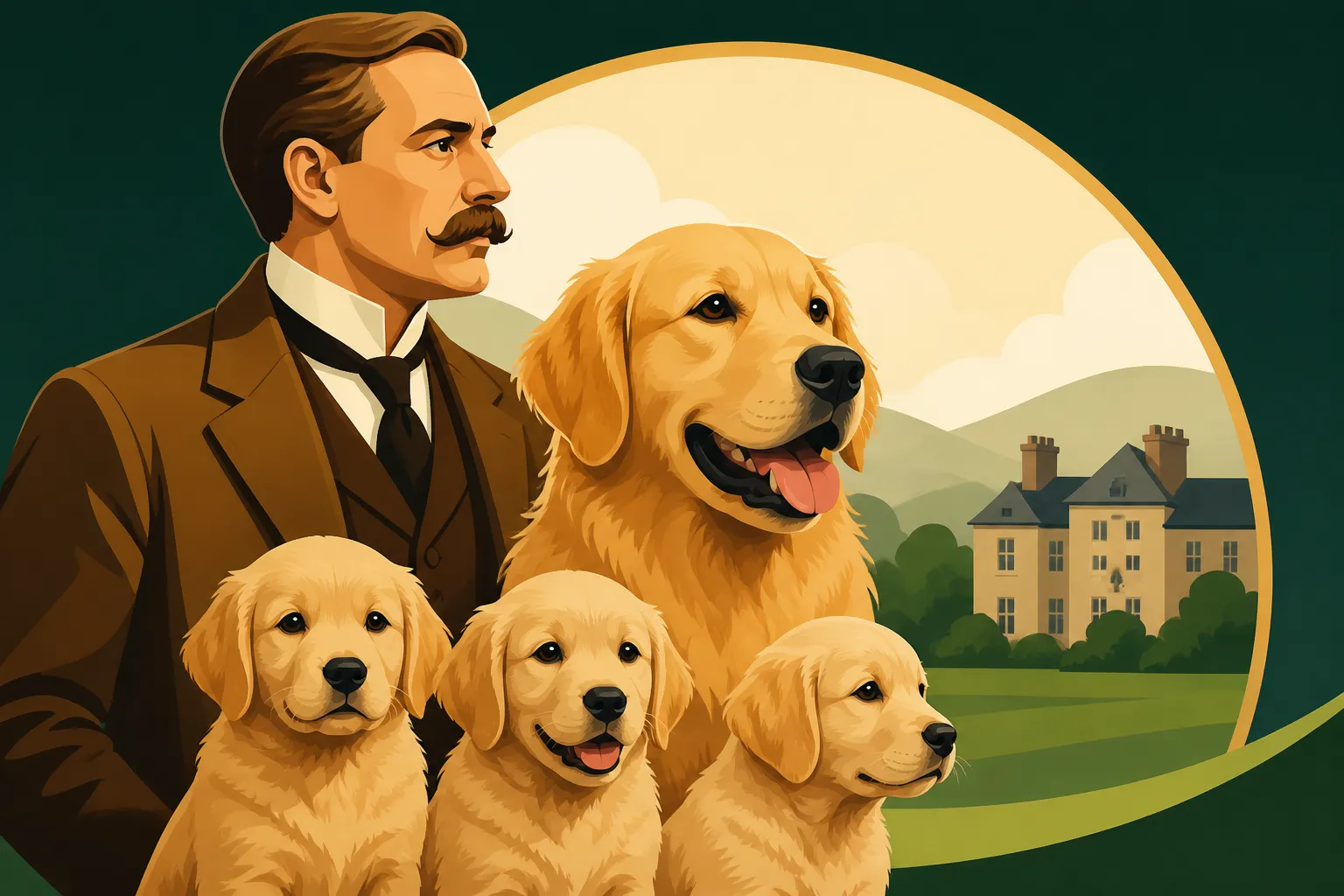
The individual responsible for the creation of the Golden Retriever was Dudley Coutts Marjoribanks, who later became the First Baron Tweedmouth. Born in 1820, Lord Tweedmouth was a prominent Scottish aristocrat, politician, and, most importantly for our story, an enthusiastic sportsman and dog fancier. He owned a vast estate called Guisachan, nestled in the Scottish Highlands near Inverness-shire, a place perfectly suited for hunting game birds like grouse and partridge.
Lord Tweedmouth was not just a casual dog owner; he was a serious and methodical breeder who sought to develop a retriever that was perfectly adapted to the challenging terrain and wet conditions of the Highlands. He was particularly frustrated with the available retrievers of his time, which often lacked the necessary "soft mouth" (the ability to carry game without damaging it) or the biddability and stamina required for long days in the field. He wasn't content with just any dog; he envisioned a specific set of traits – intelligence, strength, a good nose, a calm demeanor, and an unwavering loyalty – all wrapped in a handsome, hardy package. His vision was clear, and his dedication to achieving it was unwavering, setting the stage for the breed's eventual success.
When the Breeding Program Truly Began
So, to answer the core question: Lord Tweedmouth began his intentional breeding program for what would become the Golden Retriever in the late 1860s. More specifically, the pivotal first litter, the one considered the true genesis of the breed, was whelped in 1868. This was the year that marked the purposeful combination of the foundation sire and dam that he had carefully selected.
His efforts weren't a sudden, isolated event, but rather the culmination of years of observation, thought, and a clear understanding of genetics, even before the science of genetics was fully understood. He recognized the need for a specific type of retrieving dog and embarked on a multi-generational project to create it. This wasn't merely pairing two dogs and hoping for the best; it was a deliberate, almost scientific endeavor to blend desired traits from various established breeds into a cohesive new type. The 1868 litter was the turning point, the first tangible result of his meticulously laid plans, and it truly set the breed on its path. It wasn't until much later that the breed would gain widespread recognition and its official name, but the foundation was firmly laid in that specific year.
The Guisachan Estate: Home to the First Goldens
The birthplace of the Golden Retriever was Lord Tweedmouth's magnificent Guisachan Estate. This sprawling property in the Scottish Highlands was not just a home but a working estate, complete with vast moorlands, forests, and lochs – an ideal environment for testing and refining a new breed of retriever. It was here, amidst the rugged beauty of Scotland, that Lord Tweedmouth implemented his ambitious breeding program.
The estate provided the perfect crucible for his experiments. The dogs he bred were not merely pets; they were working animals, integral to the hunting activities that were a central part of aristocratic life. This meant that the puppies born at Guisachan were immediately exposed to the very environment they were being bred for. They learned to navigate the challenging terrain, to retrieve fallen game from dense undergrowth and cold water, and to work closely with their human handlers. The demands of the estate shaped the physical and mental attributes of the early Goldens, ensuring they were hardy, intelligent, and eager to please. The commitment to developing a dog suited for this specific environment is a testament to The Guisachan Estate Where Golden Retrievers Began and its crucial role in the breed's history. It’s a wonderful thought that the very first Golden Retrievers ran and played across those historic Scottish lands, much like our Goldens do in our backyards today (though perhaps with a bit less hunting involved!).
The Foundation Pair and Early Crosses
The story of the Golden Retriever's creation is a fascinating tapestry woven from several breeds, carefully selected and combined by Lord Tweedmouth. It wasn't about finding one perfect dog, but about intelligently blending desirable traits to produce a new, superior retriever.
Nous and Belle: The Cornerstone of the Breed
The true foundation of the Golden Retriever breed lies with two specific dogs: a yellow Wavy-coated Retriever named Nous and a Tweed Water Spaniel named Belle. Nous was purchased by Lord Tweedmouth in Brighton in 1865. He was an anomaly among his litter, being the only yellow puppy in a litter of otherwise black Wavy-coated Retrievers. Tweedmouth, recognizing his unique color and desirable retrieving abilities, brought him to Guisachan.
Belle, on the other hand, was a Tweed Water Spaniel, a now-extinct breed known for its brown, curly coat, excellent water retrieving skills, and gentle nature. These dogs were smaller than many retrievers of the time but possessed incredible intelligence and a strong desire to work. Lord Tweedmouth chose Belle for her exceptional field abilities and her calm disposition. The fateful pairing of Nous and Belle in 1868 produced a litter of four yellow puppies. These puppies, named Crocus, Cowslip, Primrose, and Ada, are recognized as the first true Golden Retrievers. This specific pairing and litter are meticulously documented in Lord Tweedmouth's private studbook, which was kept at Guisachan, providing undeniable proof of the breed's origins and laying the myth of the Russian circus dogs firmly to rest. You can read more about Nous and Belle: The Golden Retriever's Foundation Pair to really understand how significant this duo was.
The Strategic Use of Other Breeds
While Nous and Belle were the primary foundation, Lord Tweedmouth didn't stop there. He strategically introduced other breeds into his lines over the next couple of decades to refine specific traits he desired. His goal was to create a dog that excelled in retrieving game while also possessing the gentle temperament and striking appearance we associate with Goldens today.
One of the most notable influences was the Irish Setter, introduced to enhance the richness of the coat color and potentially improve scenting abilities. A Bloodhound was also used in one instance, likely to imbue the line with its legendary tracking nose and perhaps some of its calm, dignified demeanor. There's also evidence of a black Flat-coated Retriever being bred into the lines. Each cross was carefully planned, with specific intentions to either solidify existing traits or introduce new ones that would benefit the breed's overall functionality and aesthetic. This wasn't haphazard mixing; it was a deliberate, thoughtful process of selective breeding. The importance of What Breeds Went Into the First Golden Retrievers cannot be overstated, as each contributed to the Golden Retriever’s unique blend of characteristics. Imagine the careful consideration that went into each pairing, far removed from simply picking a puppy from a litter at your local PetSmart or browsing for supplies on Chewy.
Documenting the Lineage: The Guisachan Kennel Books
One of the most remarkable aspects of Lord Tweedmouth's breeding program, and indeed what allowed the true history of the Golden Retriever to eventually come to light, was his meticulous record-keeping. He maintained detailed studbooks, known as the Guisachan Kennel Books, from 1868 all the way up until his death in 1894. These books were not just simple breeding logs; they contained comprehensive information about every mating, every litter, and the various crosses he made.
These hand-written records detailed not only the names of the sires and dams but also their parentage, the number of puppies in each litter, their colors, and even notes on their dispositions and working abilities. It was these incredibly thorough documents, rediscovered and published in 1952 by his great-nephew, Lord Ilchester, that finally provided irrefutable evidence of the Golden Retriever's true origins and definitively debunked the Russian circus dog myth. The existence of these records is a testament to Lord Tweedmouth's dedication and his foresight in documenting his work, providing a clear, verifiable timeline of the breed's development. This level of historical clarity is quite rare for many dog breeds, making the Golden Retriever's origin story particularly well-preserved thanks to The Stud Book That Proved the Golden's Real Origin.
The Golden Retriever's Early Purpose and Development
The Golden Retriever didn't just appear fully formed; it was painstakingly developed with a specific job in mind, and that purpose shaped its physical attributes and endearing personality.
Bred for the Scottish Highlands: A Retriever's Role
The primary motivation behind Lord Tweedmouth's breeding program was the need for a superior retriever perfectly suited to the challenging hunting conditions of the Scottish Highlands. Hunting estates like Guisachan would host large shooting parties, where numerous game birds, such as grouse, partridge, and pheasant, would be shot. These birds often fell in dense undergrowth, boggy terrain, or into cold lochs and rivers. The existing retriever breeds of the time often struggled with these conditions. They might have been good on land but poor in water, or vice-versa, or perhaps lacked the stamina for long days, or were too rough with the retrieved game.
Lord Tweedmouth sought a dog that could operate effectively in both wet and dry conditions, possess a superb sense of smell to locate fallen birds, exhibit great endurance, and, crucially, retrieve game gently without damaging it – the hallmark "soft mouth" for which Goldens are famous. The environment of the Scottish Highlands was not just a backdrop; it was a key factor driving the selection criteria for his new breed. The thick, water-resistant double coat, the powerful swimming ability, and the innate desire to carry objects all stem from this original purpose. This deep connection to their working heritage is why What Golden Retrievers Were Bred to Do continues to influence their behavior and needs even today.
The Traits Tweedmouth Sought
Lord Tweedmouth was not just breeding for a good-looking dog; he had a very specific set of characteristics in mind that would make his ideal retriever. He meticulously selected for these traits through generations, creating a blueprint for the Golden Retriever's enduring personality and abilities.
Firstly, a "soft mouth" was paramount. A retriever that crushed the game it retrieved was useless. Goldens are renowned for their ability to carry delicate objects gently, a direct legacy of this requirement. Secondly, intelligence and biddability were crucial. A dog that could understand commands and was eager to please would be far more effective in the field. This foundation is why Goldens are so often seen as easy to train and quick learners, whether for complex tasks or simple commands. Thirdly, stamina and resilience were essential for long days of hunting in varied, often harsh, Scottish weather. They needed to be robust dogs, capable of sustained effort without tiring. Finally, a calm, loyal temperament was highly valued. These dogs worked closely with people and were also family companions. This combination of traits is what gives the Golden Retriever its iconic Golden Retriever Temperament and What to Expect: friendly, intelligent, devoted, and always ready for a job or a cuddle. It’s a carefully crafted disposition, not just happenstance.
From Private Estate to Public Recognition
For many years, the Golden Retriever was largely known only within Lord Tweedmouth's circle and among a few select hunting enthusiasts who admired his dogs. The breeding program was a personal passion, not initially intended for widespread public distribution or official breed recognition. The dogs were simply "Tweedmouth Retrievers" or sometimes "Yellow Retrievers" on the estate. The term Why Goldens Were Once Called Yellow Retrievers perfectly captures this early, informal naming convention.
As the dogs proved their exceptional abilities and gentle nature, their reputation gradually spread. Other noblemen and sportsmen acquired puppies from Guisachan. It wasn't until the early 20th century that interest grew significantly enough for concerted efforts to gain official recognition. In 1903, the breed was first registered with the Kennel Club of Great Britain as "Flat Coats – Golden." They were then classified as "Retrievers (Golden and Yellow)" in 1913, and finally, in 1920, they were officially recognized as the "Golden Retriever." The breed made its way across the Atlantic, gaining traction in North America and eventually being recognized by the American Kennel Club. When the AKC Recognized the Golden Retriever marked a significant milestone, cementing their place in dog history. Today, the Golden Retriever's journey from a private Scottish estate to one of the world's most beloved and recognized breeds is a testament to the enduring vision of Lord Tweedmouth.
| Key Event | Approximate Year(s) | Description |
|---|---|---|
| Lord Tweedmouth's Birth | 1820 | Dudley Coutts Marjoribanks, the breed's founder, is born. |
| Nous Acquired | 1865 | Lord Tweedmouth purchases Nous, a yellow Wavy-Coated Retriever. |
| First Golden Litter | 1868 | Nous is bred with Belle (Tweed Water Spaniel), producing the first litter of "yellow retrievers." |
| Guisachan Kennel Books | 1868-1894 | Lord Tweedmouth meticulously documents his breeding program, creating a verifiable lineage. |
| Strategic Outcrosses | 1870s-1880s | Irish Setter, Bloodhound, and Flat-Coated Retriever lines introduced to refine desired traits. |
| Lord Tweedmouth's Death | 1894 | The extensive breeding program at Guisachan concludes. |
| First KC Registration | 1903 | The breed is first registered with the Kennel Club of Great Britain as "Flat Coats – Golden." |
| Official Name "Golden Retriever" | 1920 | The breed receives its permanent name by the Kennel Club of Great Britain. |
| AKC Recognition | 1925 | The Golden Retriever is recognized by the American Kennel Club, solidifying its presence in the U.S. |
| Guisachan Kennel Books Published | 1952 | Lord Ilchester publishes his great-uncle's records, officially confirming the breed's true origins. |
Disclaimer
This article is for general informational purposes only and does not constitute professional advice. Laws, prices and regulations vary by location and change over time. Consult a qualified professional for guidance on your specific situation.