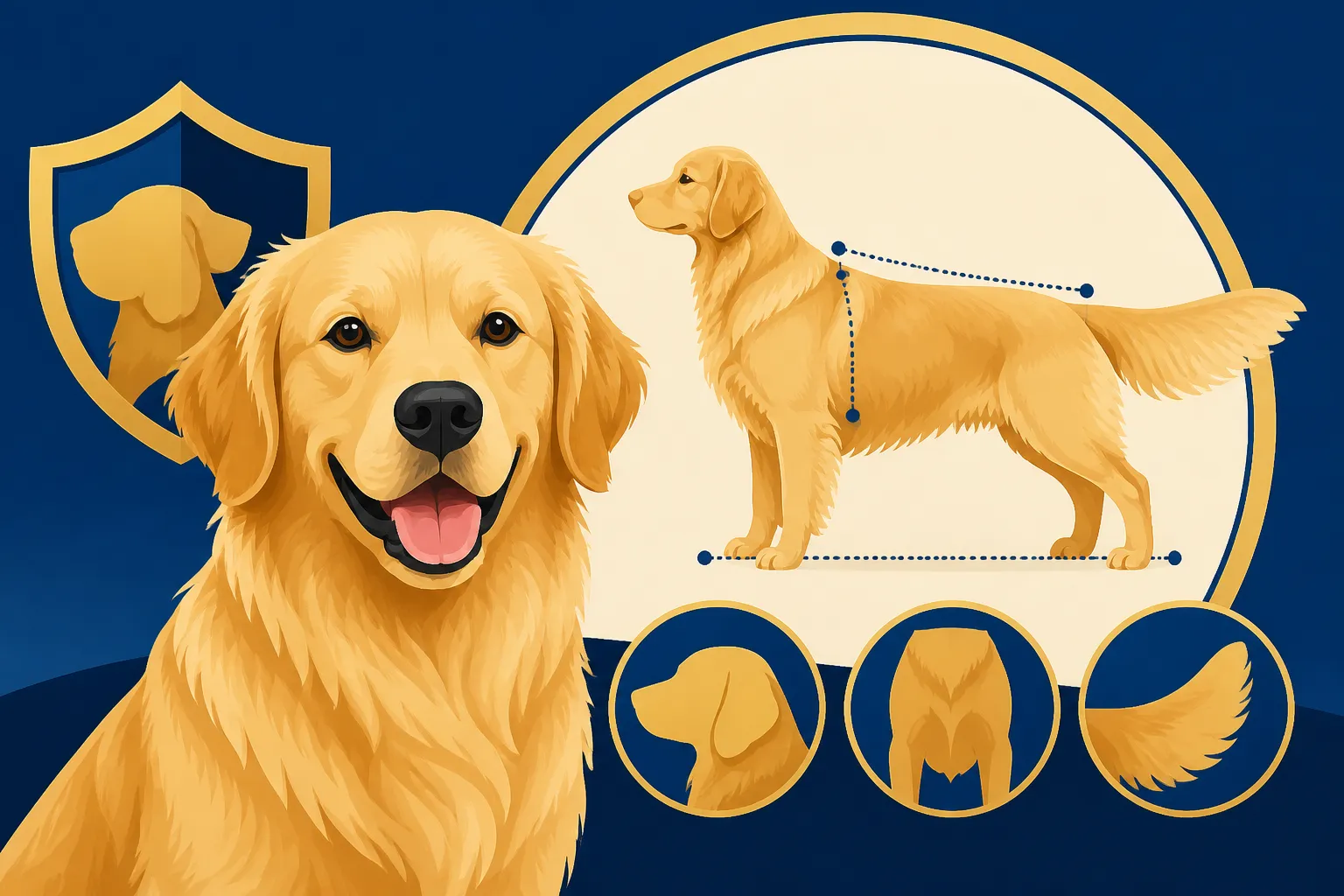
The AKC Golden Retriever Breed Standard
Many wonderful folks bring a Golden Retriever into their lives because they’re drawn to that universally adored sunny disposition and gorgeous flowing coat. But beneath that friendly smile and wagging tail is a carefully crafted dog, defined by a specific set of characteristics laid out in the AKC Golden Retriever Breed Standard. Understanding this standard isn't just for show breeders; it helps every owner appreciate the thoughtful design behind their beloved companion and recognize what makes a Golden a Golden. This guide will take you through the intricacies of that standard, breaking down each element from head to tail so you can truly understand the blueprint of this incredible breed.
Understanding the Golden Retriever Breed Standard's Purpose
When you first hear "breed standard," it might sound a bit exclusive, like it's only for the fancy dog show crowd. But that couldn't be further from the truth. The Golden Retriever breed standard is actually a vital document for anyone who cares about the integrity, health, and characteristic temperament of these beloved dogs. It's not just about aesthetics; it's about preserving the very essence of what makes a Golden Retriever.
Why Breed Standards Exist
Think of a breed standard as the official description of the ideal dog of a particular breed. It outlines the physical characteristics, temperament, and movement that are considered desirable and typical for that breed. These standards aren't just pulled out of thin air; they're developed by national breed clubs, like the Golden Retriever Club of America, and approved by governing kennel clubs, such as the American Kennel Club (AKC). Their primary purpose is to maintain the distinctiveness and purity of each breed, ensuring that future generations continue to exhibit the traits for which they were originally developed.
For Golden Retrievers, this means preserving their friendly nature, their eagerness to please, and their physical capabilities as a retrieving gun dog. Without a standard, breeders might make choices based purely on personal preference, leading to a dilution of breed-specific traits or, worse, introducing undesirable health or temperament issues. It's a guiding light, a historical document that reminds us of the breed's origins and its intended role.
How the AKC Standard Guides Breeders
For responsible breeders, the AKC Golden Retriever Breed Standard is their Bible. Every breeding decision, from selecting a sire and dam to evaluating a litter of puppies, is ideally made with the standard in mind. They're looking for dogs that conform as closely as possible to this ideal, not just in terms of how they look, but how they move, how they interact, and even the texture of their coat. It helps them identify strengths and weaknesses in their breeding stock and aim for continuous improvement within the breed.
Imagine a breeder trying to choose which puppy in a litter has the most potential. They won't just pick the cutest one. They'll assess the puppy's structure—its angles, its proportions, how it stands and moves—all against the backdrop of the standard. This isn't about creating perfect dogs, which don't exist, but about making informed choices that steer the breed towards health, longevity, and the preservation of its most cherished traits. They'll also use it to explain why certain puppies might be "pet quality" versus "show potential," helping new owners understand the nuances.
The Standard as a Blueprint for Health and Function
Beyond beauty and breed type, the standard is deeply intertwined with a Golden Retriever's health and functional ability. For example, the standard describes the ideal angulation of the shoulders and hips. This isn't just for looking good in the show ring; correct angulation allows a Golden Retriever to move efficiently, tirelessly retrieving game for hours without undue strain on their joints. Poor structure, deviating from the standard, can predispose a dog to issues like Golden Retriever Hip and Elbow Dysplasia Explained or arthritis later in life.
Similarly, the described coat type isn't just about fluffiness. A Golden's dense, water-repellent double coat is crucial for its original purpose of retrieving in cold water and harsh weather. Deviations, like a sparse or overly soft coat, would compromise its ability to perform its job and even its comfort. So, when breeders adhere to the standard, they are, in essence, striving to produce healthy, functionally sound dogs capable of living long, active lives, whether they're competing in field trials, offering therapy, or simply being a beloved family pet.
General Appearance: The Golden Retriever's Overall Impression
When a Golden Retriever walks into a room, there's an undeniable presence. The AKC breed standard begins by capturing this initial impression, emphasizing the harmonious balance, characteristic temperament, and appropriate size that define the breed. It's about more than just individual parts; it's about how they all come together to create that quintessential Golden look and feel.
Balance and Symmetry
The standard emphasizes that a Golden Retriever should be a "symmetrical, powerful, active dog, sound and well put together." What does "well put together" mean? It means all the parts fit. No single feature should be exaggerated or appear out of proportion to the rest of the dog. For instance, a Golden shouldn't have an enormous head on a dainty body, or exceptionally long legs that look awkward. Everything should flow smoothly, creating a picture of effortless grace and strength.
Imagine looking at a beautiful piece of art or a well-designed machine; there's a sense of rightness, where every component contributes to the overall function and aesthetic. That's what the standard seeks in a Golden Retriever. This balance is critical for their athleticism. A dog with balanced angulation in both front and rear will have a fluid, efficient gait, capable of sustained activity. It’s this overall harmonious construction that allows a Golden to be both beautiful and a capable working companion.
Temperament: The Hallmark Trait
Perhaps the most defining characteristic, and one that the standard places paramount importance on, is the Golden Retriever's temperament. The standard describes it as "kindly, friendly, and eager to please." This isn't just a suggestion; it's non-negotiable for the breed. A Golden who is shy, aggressive, or overly boisterous to the point of being uncontrollable, regardless of its physical beauty, would be considered faulty under the standard. Golden Retriever Temperament and Personality is truly the cornerstone of the breed.
This characteristic temperament is why Goldens excel as family pets, therapy dogs, and service animals. Their inherent desire to work cooperatively with humans, coupled with their gentle nature, makes them adaptable and beloved companions. When evaluating a Golden, even in a show ring, a judge will observe the dog's demeanor. A happy, confident, and approachable dog that greets the judge with a wagging tail exemplifies the breed's ideal temperament. Breeders work hard to select for these traits, understanding that temperament is often genetically inherited, making it just as important as physical structure.
Size and Substance: Neither Too Fine Nor Too Coarse
The standard provides very specific guidelines for Golden Retriever Size and Adult Proportions, including height and weight. For males, the ideal height is between 23 and 24 inches at the shoulder, with females being 21.5 to 22.5 inches. Weights are also given, typically 65-75 pounds for males and 55-65 pounds for females, reflecting a substantial, well-muscled body. The key here is "substance" – a Golden should feel sturdy and strong, not fragile or delicate, but also not bulky or obese.
A Golden Retriever should possess good bone, meaning their skeletal structure is strong enough to support their frame without appearing heavy. They need to be agile and able to move through varied terrain, so being too heavy or too light would hinder their working ability. Breeders strive for that sweet spot where a Golden is powerful enough to carry a retrieve, yet athletic enough to do so gracefully. Too large or too small can also impact their health, putting undue stress on joints or making them less resilient in the field.
The Golden Retriever Head: Expression and Intelligence
The head of a Golden Retriever is often the first thing people notice, and for good reason. It’s where that characteristic "kindly" expression truly shines, reflecting the breed's intelligence and gentle nature. The breed standard meticulously details the desired shape, proportions, and features of the head, as these elements profoundly influence both the dog's appearance and its functional capabilities.
Skull and Muzzle Proportions
According to the AKC standard, a Golden Retriever's head should be "broad in skull, not coarse or heavy, well set on a clean, muscular neck." The skull should be broad between the ears, transitioning smoothly into a powerful, deep muzzle. Crucially, the muzzle should be "straight in profile, blending smoothly and strongly into the skull; when viewed in profile or from above, it should taper only slightly from base to tip." The length of the muzzle should be approximately equal to the length of the skull, measured from the stop (the indentation between the eyes) to the occiput (the prominent bone at the back of the head).
This balanced proportion is essential. A muzzle that is too short, often called "snipy," or too long can disrupt the dog's ability to efficiently retrieve, as it affects jaw strength and how they hold objects. A well-defined stop, but not an abrupt one, leads to that soft, intelligent look. Imagine a Golden carrying a pheasant in its mouth; a well-proportioned, strong muzzle is critical for a "soft mouth" grip that doesn't damage the bird, yet holds it securely. This balance in the head gives the Golden that classic, appealing profile we all adore.
Eyes and Eye Rims: A Kind Expression
The eyes are often called the windows to the soul, and for Golden Retrievers, they are absolutely central to their characteristic expression. The standard calls for eyes that are "friendly and intelligent, medium large, dark brown and set reasonably far apart." The eye rims should be dark, giving the eyes definition and preventing a washed-out appearance. Light-colored eyes or eyes that are set too close together or too far apart detract from the ideal expression.
The placement and color of the eyes are vital for two main reasons. Firstly, they contribute heavily to the Golden's renowned "kindly" and gentle look. A Golden with dark, expressive eyes projects warmth and intelligence, traits that are hallmark to the breed. Secondly, correct eye placement can impact vision, especially in the field where a wide field of view is advantageous for spotting falling birds. Dark eye rims also offer some protection from glare and are less prone to irritation than lighter, unpigmented rims, which could be a functional advantage.
Ears: Set and Size
A Golden Retriever's ears are another key feature described in the standard. They should be "relatively short, attached well behind and just above the eye, and falling close to the cheek." When pulled forward, the tip of the ear should just reach the inner corner of the eye. Ears that are too long, too low-set, or too high-set change the entire look of the head and are considered faults.
The ear set and size are important for both aesthetics and function. Ears that are correctly set frame the head beautifully, contributing to that soft, intelligent expression. From a functional perspective, while not as crucial as in breeds with erect ears, the Golden's ear set is part of the overall head structure that aids in sound localization. Also, ears that are disproportionately large or small wouldn't fit the harmonious balance of the Golden's head. Breeders pay attention to these details to ensure that the puppies they produce align with the breed's established, cherished characteristics.
Neck, Topline, and Body: Structure for Function
Beneath the flowing coat, a Golden Retriever's body is a marvel of functional design, built for endurance and agility. The AKC standard describes a powerful, athletic physique, where every element of the neck, topline, and body contributes to the dog's ability to work tirelessly and move gracefully. This isn't just about looking good; it's about being able to perform the demanding tasks they were originally bred for.
Strong Neck and Level Topline
The standard dictates a neck that is "medium long, merging gracefully into well laid back shoulders, giving a sturdy, muscular appearance." This strong, well-muscled neck is crucial for a retrieving dog. Imagine a Golden plunging into icy water to retrieve a heavy duck – a powerful neck is necessary to hold the quarry securely and carry it back to shore without strain. A neck that is too short or too long would hinder this function, making the dog less efficient in its work.
The topline, which is the dog's back, should be "level from the withers to the slightly sloping croup." A level topline provides a stable platform for movement and supports the dog's entire structure. It indicates proper spinal alignment and musculature. Deviations, such as a "roach back" (arched over the loin) or a "sway back" (dipping behind the withers), are considered faults as they impair movement and can indicate structural weakness. A strong, level topline is a hallmark of a sound, athletic Golden Retriever, reflecting years of careful breeding to produce a dog capable of sustained physical activity.
Ribs and Chest Depth
The standard describes the body as "well balanced, short coupled, deep and well-sprung throughout the rib cage." "Short coupled" means the distance between the last rib and the hip bone is relatively short, contributing to strength and agility. The chest should be "deep and wide with well-sprung ribs, extending well back to the short couplings." This deep, broad chest allows for ample lung and heart capacity, which is absolutely vital for a dog designed for sustained activity, such as retrieving game for hours in the field.
Well-sprung ribs create a rounded, barrel-like shape to the rib cage, providing plenty of room for vital organs. If the ribs are too flat ("slab-sided") or too round, it can affect the dog's movement and endurance. A deep chest means the breastbone extends well down, ideally to the elbows, giving the dog a robust, powerful appearance. This robust chest and rib structure are essential for a Golden to have the stamina required for a full day of hunting or any vigorous exercise.
Loin and Croup: Power and Grace
The loin is the area between the last rib and the hips, and the croup is the part of the back leading to the tail. The standard specifies that the loin should be "short, muscular, and broad, appearing to be somewhat tucked up." A strong, broad loin provides the power for propulsion and jumping. A weak or overly long loin reduces efficiency in movement and can lead to structural instability.
The croup should be "slightly sloping," meaning it falls away gently from the highest point of the hip bone to the tail set. This slight slope is important for proper tail carriage and for the efficient transfer of power from the hindquarters during movement. A croup that is too steep can result in a low tail set and less powerful rear drive, while a flat croup can disrupt the overall balance. These seemingly small details are crucial for the Golden Retriever's overall athleticism, ensuring they can move with both power and grace, whether trotting across a field or fetching a toy. What the AKC Standard Says About Golden Retriever Size factors into all these proportions.
Forequarters and Hindquarters: Movement and Endurance
A Golden Retriever's characteristic gait – that smooth, powerful, and seemingly effortless trot – is a direct result of its carefully designed forequarters and hindquarters. The AKC breed standard goes into considerable detail about the angles, bone structure, and muscle development of the limbs, as these components dictate the dog's ability to move with efficiency, power, and endurance. Without correct structure in the legs, a Golden simply cannot fulfill its purpose as a tireless retriever.
Shoulder Layback and Upper Arm
The front assembly of a Golden Retriever is critical for reach and flexibility. The standard calls for "shoulders well laid back, with shoulder blades fairly close at the withers, sloping well back from the point of the shoulder." The upper arm (humerus) should be approximately the same length as the shoulder blade, setting the elbow directly under the highest point of the shoulder blade. This specific angulation—often described as a 90-degree angle between the shoulder blade and upper arm—is paramount.
Why is this so important? Proper shoulder layback and upper arm angulation allow for optimal reach in the front stride. A dog with poorly angled shoulders will have a short, choppy gait, expending more energy to cover less ground. This would be a significant disadvantage for a retrieving dog that needs to cover large distances efficiently. It also affects the dog's balance and ability to absorb impact, preventing unnecessary strain on the joints. Breeders meticulously examine these angles, knowing they contribute directly to the dog's longevity and comfort.
Legs, Pasterns, and Feet
Moving down the forequarters, the standard requires "legs straight, with good bone, running straight down from the shoulders." The pasterns, which are the joints just above the feet, should be "short and strong, showing slight slope without weakness." Weak or long pasterns are a common fault, as they act as shock absorbers and are prone to injury if not correctly structured. Imagine a Golden running full speed and then suddenly stopping; strong pasterns are essential for handling that impact.
The feet are described as "medium size, round, compact, with thick pads." "Cat feet," where the toes are tightly arched, are preferred over "hare feet," which are longer and less compact. The toes should be "well-knuckled and well cushioned by thick pads." This type of foot provides excellent traction and durability, protecting the paws from rough terrain and prolonged activity. Strong, well-padded feet are vital for a working dog that might traverse varied landscapes, from muddy fields to rocky paths, maintaining comfort and stability.
Angulation and Drive in the Rear
The hindquarters provide the powerful drive for a Golden Retriever's movement. The standard specifies that they should be "broad and strongly muscled," emphasizing power and agility. The angulation of the stifle (knee joint) and hock (ankle joint) is crucial here. The hock joint should be "well let down" (close to the ground) and straight when viewed from the rear. "Turned out" or "turned in" hocks (cow-hocked or bow-legged) are serious faults that compromise power and can lead to injury.
Correct angulation in the rear allows for powerful propulsion, enabling the dog to leap, accelerate, and navigate obstacles with ease. When a Golden Retriever trots, the powerful push from the hindquarters should match the reach of the forequarters, creating a balanced and efficient stride. Without adequate angulation, the dog's movement will be restricted, lacking power and appearing stiff. This symmetry in angulation between front and rear is fundamental to the Golden's distinctive "free, smooth, powerful, and well-coordinated" gait, ensuring they can perform their duties effortlessly and gracefully. What Excellent, Good and Fair Mean on a Golden's Hips can reflect how well a Golden's rear angulation is developed.
The Golden Retriever's Signature Coat and Color
Perhaps no feature is more universally recognized than the Golden Retriever's beautiful, shimmering coat. The AKC standard details not just the color, but also the texture, density, and natural feathering, all of which contribute to the breed's distinct appearance and its functional capabilities as a retrieving dog. This isn't just about looks; it's about a coat designed for protection and performance.
Coat Texture and Density
The standard describes the Golden Retriever's coat as "dense and water-repellent with good undercoat." It can be "straight or wavy" but should never be curly, woolly, or excessively silky. The outer coat consists of guard hairs that are somewhat stiff and shed water, while the soft, dense undercoat provides insulation against both cold and heat. This double-coat system is a vital adaptation for a dog that works outdoors in various climates and often enters cold water.
Imagine a Golden plunging into a chilly lake to retrieve a duck; a water-repellent outer coat means less water penetrates to the skin, and the undercoat keeps them warm. A coat that is too sparse, too soft, or lacks an undercoat would not provide adequate protection, making the dog susceptible to the elements. Conversely, an overly thick or woolly coat can hinder movement and be prone to matting. Breeders are careful to maintain this balance, as the coat is a primary defense mechanism for the dog in its working environment. What Makes a Golden Retriever's Coat Water Resistant is a key part of their heritage.
Feathering and Grooming
While the body coat is described as dense, the standard also mentions "moderate feathering on the back of the forelegs and thighs, on the underside of the body and on the tail." Feathering refers to the longer hair found in these areas, which adds to the Golden's elegant appearance. This feathering should not be excessive to the point of impeding movement or becoming a management nightmare.
This moderate feathering, while beautiful, also requires regular care. The areas with longer hair can be prone to tangles and mats if not brushed regularly. For many owners, managing Golden Retriever Shedding and How to Manage It is a daily routine. While the standard dictates natural feathering, subtle trimming might be done for show purposes to present a clean outline, but the dog should never appear artificially sculpted. The goal is to enhance the natural beauty and functional lines of the dog, not to transform its natural coat.
Permissible Colors and Markings
The color of a Golden Retriever is perhaps its most defining visual trait. The AKC standard is quite specific: "rich, lustrous golden of various shades." This means any shade of gold is acceptable, from a very light, almost cream color, to a deep, rich red-gold. The Three Golden Retriever Coat Shades AKC Allows emphasizes the range within "golden." However, "extreme paleness or extreme darkness is not desirable." Dogs with coats that are either too pale (approaching white) or too dark (like a true mahogany red) are considered less desirable, though not a disqualification unless they are truly outside the golden spectrum.
The standard also states, "Any white markings, other than a few white hairs on the chest, should be penalized." This means large white patches, often seen on mixes, are not permissible in a purebred Golden Retriever. While some breeders may promote "white Goldens" or "red Goldens," the AKC standard emphasizes the broad but clear spectrum of "golden." The vibrancy and richness of the golden hue are highly valued, contributing to the breed's striking beauty. Understanding these color nuances helps distinguish a truly standard-conforming Golden from those whose colors may be outside the accepted range.
Tail and Gait: Finishing Touches of Grace
The tail and gait of a Golden Retriever are not just minor details; they are integral to the breed's overall appearance and functional integrity. The AKC standard gives specific instructions on both, ensuring that the tail complements the dog's athletic build and that its movement is efficient and harmonious. These characteristics round out the picture of a true Golden Retriever, showcasing its heritage as a capable working dog.
Tail Set and Carriage
The standard describes the tail as "well set on, following the natural line of the croup." This means it should emerge smoothly from the end of the back, without appearing too high or too low. It should be "carried level with the back or with a moderate upward curve; never curled over the back or between the legs." The tail itself should be "well feathered," forming a beautiful plume.
The way a Golden Retriever carries its tail is not just for show; it's an indicator of both temperament and structure. A tail curled over the back can sometimes indicate excitement or tension, but if consistently carried like a Husky's, it's a structural fault. A tail tucked between the legs is often a sign of fear or submissiveness, which goes against the breed's confident and friendly temperament. The ideal tail carriage, level with the back or slightly curved, reflects a balanced structure and a happy, self-assured dog. It's an extension of their topline and should move with the dog as a natural part of its body.
Movement: Free, Smooth, and Powerful
A Golden Retriever's movement, or "gait," is one of its most defining characteristics. The standard demands a gait that is "free, smooth, powerful, and well coordinated, with good reach and powerful drive." When a Golden moves, you should see effortless efficiency. The legs should move straight forward and back, with the feet converging towards a center line as speed increases (called "single tracking"). This efficiency is crucial for a dog that needs to cover a lot of ground quickly and without tiring. Golden Retriever Gait and Movement is a truly beautiful sight when correct.
Imagine watching a Golden trot across a field. You should see a harmonious flow, where the front legs reach out smoothly and the hindquarters provide a strong, driving push. There should be no wasted motion, no choppy steps, no paddling (feet swinging out), or crabbing (moving sideways). This athletic movement is a direct result of correct angulation in both the forequarters and hindquarters, coupled with strong musculature. It’s what allows them to retrieve all day without breaking down or becoming fatigued.
Undesirable Gaits and Their Implications
Deviations from the ideal gait are considered faults because they indicate structural deficiencies that can impact a Golden Retriever's ability to perform its original duties and maintain long-term soundness. For example, a short, choppy stride suggests insufficient angulation in the shoulders or hips. A high-stepping gait, where the dog lifts its feet too high, wastes energy. Dogs that "plait" (cross their front legs) or "paddle" (swing their feet out in an arc) are not moving efficiently and may indicate structural imbalances.
Beyond simply looking "wrong," these undesirable gaits can lead to premature wear and tear on joints, ligaments, and muscles. A dog that moves improperly will experience more strain during activity, potentially leading to orthopedic issues like Golden Retriever Arthritis and Joint Decline earlier in life. Therefore, assessing a Golden Retriever's gait is not just about aesthetics for the show ring; it's a critical evaluation of their underlying health, structural integrity, and functional ability to live a long, active, and comfortable life. Breeders prioritize sound movement to ensure the well-being of the breed.
Disqualifications and Serious Faults: What to Avoid
The AKC Golden Retriever Breed Standard isn't just a list of ideal traits; it also clearly outlines characteristics that are considered "faults" or, even more severely, "disqualifications." These are significant deviations that compromise the breed's integrity, function, or temperament. Understanding these is crucial for maintaining the quality of the breed and for any potential owner to recognize issues that could impact a dog's health or suitability.
Structural and Temperamental Disqualifications
Disqualifications are the most serious departures from the standard, meaning a dog exhibiting one of these traits cannot be shown in conformation events. For Golden Retrievers, specific disqualifications include:
- Undershot or Overshot Bite: The standard requires a "scissors bite." An undershot bite (lower jaw protrudes beyond upper) or overshot bite (upper jaw protrudes beyond lower) is a disqualification. This impacts the dog's ability to grasp and carry objects effectively.
- Missing Teeth: While an accidental loss doesn't disqualify, the absence of specific permanent teeth (premolars 1-4, molars 1-3) is a disqualification. A full complement of strong teeth is necessary for a retrieving dog.
- Excessive White Markings: As mentioned earlier, any white markings on the body, except for a few white hairs on the chest, are a disqualification.
- Unacceptable Colors: Black or any other color than shades of golden are disqualifying. This means no "black Goldens" in the purebred sense.
- Aggression or Extreme Shyness: A Golden Retriever's temperament is paramount. A dog that is aggressively shy, showing fear biting, or outright aggression towards people or other dogs, is disqualified. This is a critical point, as it speaks to the very heart of the breed.
These disqualifications are not arbitrary. They often point to significant genetic or structural issues that would undermine the Golden Retriever's function, health, or most importantly, its renowned temperament. Disqualifications in the Golden Retriever Standard are clear markers for what is unacceptable in the breed.
Understanding Faults Versus Disqualifications
It's important to distinguish between a "fault" and a "disqualification." A fault is a deviation from the ideal that detracts from the dog's overall quality but does not necessarily render it unsuitable for breeding or disqualify it from the show ring. Faults are often described with varying degrees of severity (e.g., "minor fault," "serious fault"). The more severe the fault, the more it impacts the dog's ability to conform to the standard and potentially its function or health.
Examples of serious faults in Goldens include:
- Lack of Pigmentation: A noticeable lack of pigment on the nose or eye rims, giving a "pink" or "flesh-colored" appearance, is a serious fault. Dark pigment is important for protection from the sun and is characteristic of the breed.
- Poor Tail Carriage: A tail carried perpetually between the legs (indicating fear) or curled over the back is a serious fault.
- Structural Deficiencies: Major deviations in angulation (e.g., straight shoulders, insufficient rear angulation), weak pasterns, or a poor topline are serious faults because they impair movement and can lead to orthopedic problems.
- Temperament Issues: While extreme aggression or shyness are disqualifying, a timid or overly boisterous temperament that is difficult to manage would be a serious fault, as it deviates from the ideal "kindly and eager to please" nature.
Judges penalize faults according to their severity, and a dog with too many or very serious faults would not be placed in a conformation competition. For breeders, understanding these faults helps them make informed decisions about their breeding program, aiming to minimize the recurrence of such traits.
The Importance of Soundness
Ultimately, the standard's emphasis on avoiding serious faults and disqualifications boils down to one critical concept: soundness. A sound Golden Retriever is one that is physically and mentally healthy, structurally correct, and temperamentally stable. They can perform their duties without pain or discomfort, move with ease, and interact appropriately with their world. What Judges Look For in a Golden Retriever includes a strong focus on soundness.
When you're looking for a Golden Retriever puppy, a reputable breeder will be transparent about how their dogs conform to the standard, including any minor faults they might have. They understand that while no dog is perfect, striving for soundness in all aspects—temperament, health, and structure—is paramount. This dedication ensures that the Golden Retriever breed continues to thrive as healthy, happy, and functional companions for generations to come. It’s about more than just a pretty face; it’s about preserving the whole package of what makes a Golden Retriever truly golden.
| Characteristic | AKC Standard Description (Ideal) | Common Faults | Disqualifications |
|---|---|---|---|
| Temperament | Kindly, friendly, eager to please, intelligent | Timidity, shyness, overly boisterous, stubbornness | Aggression, extreme shyness with fear biting |
| Head | Broad skull, balanced muzzle, dark eyes, short ears | Snipy or overly long muzzle, light eyes, low/high ear set, abrupt stop | Undershot/overshot bite, missing specific teeth |
| Neck & Body | Medium long, muscular neck, level topline, deep chest, short loin | Swayback, roach back, shallow chest, slab-sided ribs, long loin | (No direct body disqualifications, but severe structural issues would count as faults) |
| Forequarters | Well laid back shoulders, straight legs, strong pasterns, compact feet | Straight shoulders, weak pasterns, splayed feet, toeing in/out | (None directly, but severe lameness could impact evaluation) |
| Hindquarters | Broad, muscular, good angulation, well let down hocks | Straight stifles, cow-hocked, bow-legged, poor drive | (None directly, but severe lameness could impact evaluation) |
| Coat | Dense, water-repellent, good undercoat, straight/wavy | Silky, woolly, overly sparse, very short | Black, or any color other than shades of golden |
| Tail | Well set on, level with back or slight curve, well feathered | Curled over back, carried between legs, too short/long | (None directly, but extreme carriage could be considered a fault) |
| Color | Rich, lustrous golden of various shades | Extreme paleness (approaching white), extreme darkness | Black, or any color other than shades of golden |
| Markings | Few white hairs on chest permissible | White markings on body/feet | Any white marking other than a few white hairs on the chest |
Disclaimer
This article is for general informational purposes only and does not constitute professional advice. Laws, prices and regulations vary by location and change over time. Consult a qualified professional for guidance on your specific situation.