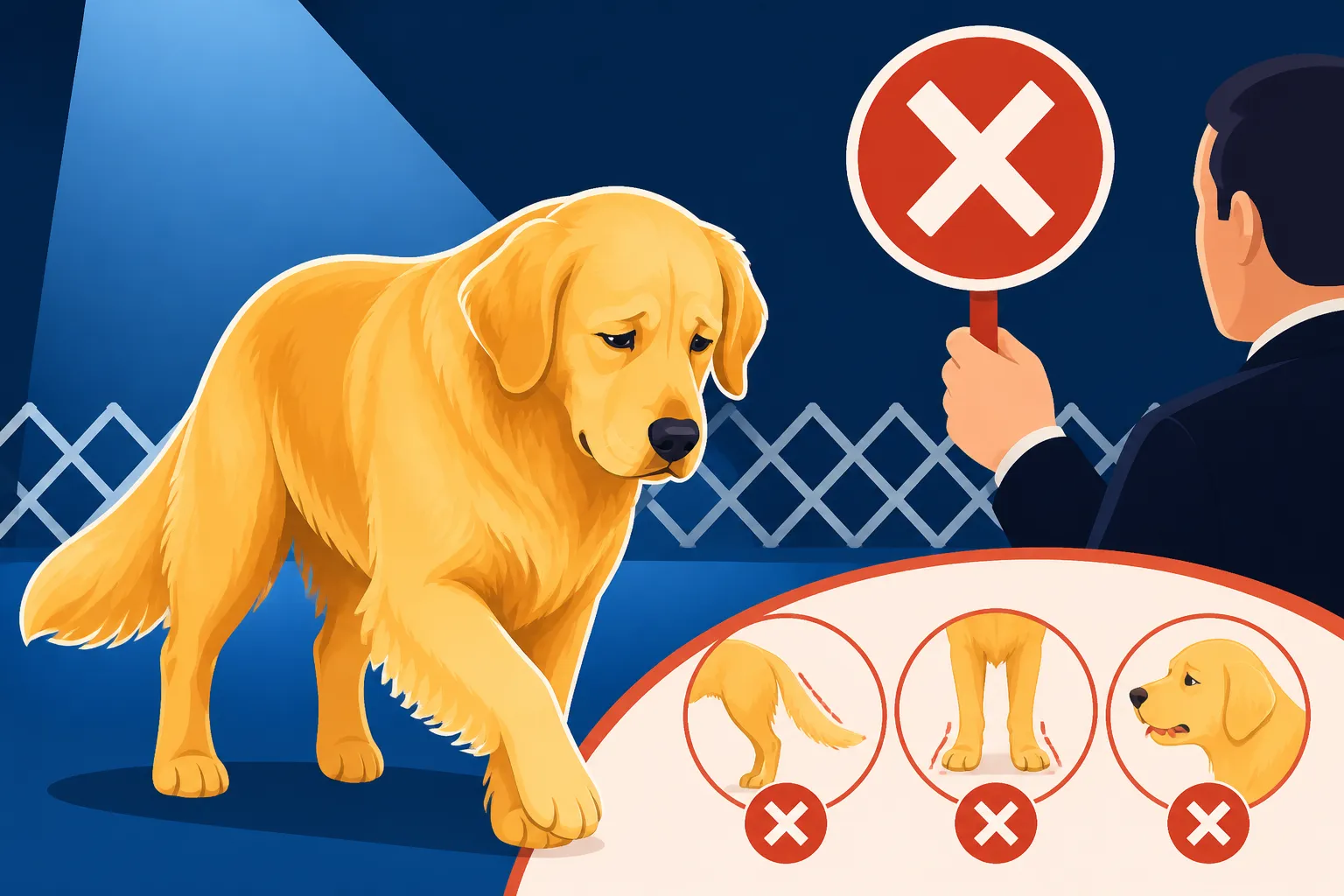
Faults That Cost a Golden Retriever in the Ring
If you've ever watched a Golden Retriever gracefully move around a show ring, you might marvel at their beauty and poise, but you might also wonder what exactly the judges are looking for and, perhaps more importantly, what they're not looking for. It's a complex dance of genetics, conditioning, and presentation, and for every perfect attribute, there's a potential "fault" that can cost a dog valuable points, or even disqualify them entirely. This guide will help you understand the specific characteristics that judges consider faults in the conformation ring, shedding light on why even small deviations from the breed standard can significantly impact a Golden Retriever's chances.
Deciphering the Golden Retriever Breed Standard
Before we dive into what counts as a "fault," it's crucial to understand the foundation: the breed standard itself. For Golden Retrievers, particularly in the United States, the American Kennel Club (AKC) breed standard is the bible that judges use to evaluate every dog in the ring. This document is a detailed word picture of the ideal Golden Retriever, covering everything from their temperament and gait to the precise shape of their head and the color of their coat. It describes the characteristics that define the breed and differentiate it from all others.
What the Standard Represents
Think of the breed standard not as a wish list, but as a blueprint developed over decades by dedicated breeders and enthusiasts. Its purpose is to preserve the breed's functional qualities and distinctive appearance. Judges aren't looking for the "prettiest" dog in a subjective sense; they're looking for the dog that most closely embodies this written ideal. Every word in the standard is there for a reason, often tied back to the Golden Retriever's original purpose as a retrieving gun dog. For instance, a strong, level back is vital for carrying game, and a waterproof double coat is essential for working in cold water. Understanding The AKC Golden Retriever Breed Standard is the first step to truly appreciating the nuances of judging.
How Judges Apply the Standard
When a Golden Retriever enters the show ring, the judge is essentially comparing that living, breathing dog against the ideal described in the standard. They assess the dog's overall balance, proportion, and structure, then move on to finer details like eye color, ear set, and tail carriage. They also observe the dog in motion, evaluating its gait for efficiency, reach, and drive. Each deviation from the ideal is considered a "fault," and these faults are weighted differently – some are minor, some are serious, and some are disqualifying. It’s a very systematic and objective process, not just a beauty contest. The goal is to identify breeding stock that will continue to produce healthy, type-correct Golden Retrievers for generations.
Common Physical Faults That Cost Points
Many of the faults that can hinder a Golden Retriever in the show ring are physical, pertaining to their anatomy and appearance. These are often the easiest for a novice to spot, but judges look for them with an incredibly discerning eye, noticing deviations that the average person might never consider.
Coat, Color, and Condition Anomalies
The Golden Retriever is renowned for its beautiful, lustrous coat. The standard describes a dense, water-repellent double coat, with a firm, straight or wavy outer coat and a thick undercoat. "Feathering" is present on the back of the forelegs, thighs, underbelly, and tail.
- Incorrect Coat Texture or Amount: A coat that is too sparse, too silky, or overly wiry is a fault. A lack of proper undercoat, or a coat that is soft and fluffy, especially on the body, would be penalized. Similarly, a Golden with an excessively long, shaggy coat that obscures its outline can lose points.
- Off-Standard Colors: The breed standard specifies that the coat color should be "rich, lustrous golden of various shades." While shades can range from light golden to dark golden, extremely light cream or very dark red coats can be considered deviations. Any white markings, other than a few white hairs on the chest, are faults. Dogs with coats that are excessively light, verging on white, or mahogany red, can lose out. You can learn more about the allowed variations in The Three Golden Retriever Coat Shades AKC Allows.
- Poor Condition: Even a perfectly structured dog can lose points if its coat is not in peak condition. This includes dullness, excessive shedding, mats, or a generally unkempt appearance. While a good diet and proper grooming, perhaps with products easily found on Chewy, can significantly help, some issues are inherent to the dog's coat type. Judges want to see a dog presented in its best light.
Structural Deviations from Head to Tail
The Golden Retriever breed standard is incredibly precise about the dog's physical structure, as each component contributes to its overall balance, athleticism, and function.
- Head and Expression: The head is a crucial indicator of breed type. Faults here include a domed or coarse skull, a dish face, a snipey muzzle, or weak lower jaw. Eyes that are too light (lemon yellow), too dark, too close-set, or too round can detract from the desired "kindly expression." Ears that are too long, too short, or incorrectly set (either too high or too low) are also considered faults. For a deeper dive, check out Golden Retriever Head, Muzzle and Expression.
- Neck and Topline: A Golden's neck should be medium long, merging smoothly into well laid back shoulders, allowing for proud head carriage. A short, thick neck or a ewe neck (one that curves inward) is undesirable. The topline should be strong and level from withers to slightly sloping croup, whether standing or moving. A roached (arched) back, a soft or sagging back, or an excessively sloping croup are all faults.
- Body and Chest: The body should be well-balanced and neither too long nor too short. A barrel chest or a chest that is too narrow and shallow lacks the necessary lung and heart room for endurance. Ribs should be long and well-sprung, not flat. A tucked-up abdomen, like that of a sighthound, is also not characteristic of the breed.
- Tail: The tail should follow the natural line of the croup, carried level or with a slight upward curve, never curled over the back or carried between the legs. It should reach to the hock, and excessive feathering can make it appear longer. A "gay tail" (one carried too high) is a common fault.
- Legs and Feet: This is where function truly meets form. Legs should be straight with strong bone. Faults in the forequarters include straight shoulders, short upper arms, weak pasterns, or splayed feet. For the hindquarters, common faults involve incorrect angulation (either too straight or over-angulated, leading to a "sickle hock"), cow hocks (hocks that turn inward), or open, splayed feet. Small, cat-like feet or large, hare-like feet are also deviations. Proper structure is essential for movement, as discussed in Golden Retriever Hip and Elbow Dysplasia Explained, though these are structural, not necessarily show faults unless they severely impact gait.
Temperament and Movement: Less Obvious Faults
While physical attributes are often the most visible, a Golden Retriever's temperament and how they move are equally critical, and judges pay very close attention to these aspects. A dog might have a beautiful coat and perfect proportions, but if it doesn't move correctly or display the characteristic Golden temperament, it won't fare well.
Gait and Movement Imperfections
A Golden Retriever's movement should be effortless, powerful, and coordinated. Judges observe the dog from all angles as it trots around the ring.
- Lack of Reach and Drive: The ideal gait involves good reach in the front (the front legs extending well forward) and powerful drive from the rear (the hind legs pushing strongly). A choppy gait, short strides, or paddling (feet swinging outward) are all faults. Lack of coordination or a lumbering gait indicates structural problems that hinder efficiency. You might notice these issues if your Golden struggles with long walks, or if they just don't seem to glide like a typical Golden. For more on this, consider reading Golden Retriever Gait and Movement.
- Topline in Motion: Even if the topline appears level when standing, it should remain firm and level when the dog moves. A soft back that sways or an arched back that rounds up during movement indicates a structural weakness that judges will penalize.
- Crabbing or Side-Winding: This occurs when a dog moves with its body slightly angled, rather than straight, usually to compensate for structural imbalances. While some dogs naturally crab slightly, excessive crabbing is a fault because it demonstrates inefficiency in movement. A Golden Retriever should move in a straight line, with its hind feet tracking directly behind its front feet.
Temperament Issues in the Ring
The Golden Retriever's famous temperament is not just a beloved trait; it's an integral part of the breed standard. The standard explicitly calls for a "kindly, friendly, and eager-to-please" demeanor.
- Shyness: A Golden Retriever that is shy, timid, or excessively nervous in the ring is a serious fault. This breed is meant to be confident and outgoing. A dog that shrinks from the judge, pulls away from examination, or constantly looks to its owner for reassurance is not displaying the desired temperament. This isn't just about a dog being uncomfortable; it speaks to the core character of the breed. You certainly wouldn't expect a typical Golden to be shy when a stranger, perhaps a friendly delivery driver from Chewy, approaches with a package.
- Aggression or Hostility: Any sign of aggression, whether toward the judge, other dogs, or even its handler, is a disqualifying fault. Golden Retrievers are absolutely not supposed to be aggressive. While fear can sometimes manifest as aggression, the breed standard is clear: such behavior is unacceptable.
Disqualifying Faults: The Absolute Dealbreakers
Some faults are so severe, so far outside the defining characteristics of the Golden Retriever, that they lead to an immediate disqualification from the show ring. These are not merely points deductions; they mean the dog cannot place in competition. These faults are typically clear-cut and undeniable. For a broader understanding of breed disqualifications, see Disqualifications in the Golden Retriever Standard.
Temperament-Based Disqualifications
As mentioned, temperament is paramount for Golden Retrievers. Any display of aggression or pronounced shyness is an instant disqualification.
- Aggression: This is the most serious temperament disqualification. If a Golden Retriever growls, snaps, bites, or even lunges at a judge, handler, or another dog, it is immediately removed from the ring. This reinforces the breed's reputation as a gentle, family-friendly companion.
- Extreme Shyness: While shyness is a fault, extreme shyness, where a dog actively shies away from examination by the judge, or tries to escape the ring, can also lead to disqualification. The Golden Retriever should present itself confidently and allow the judge to conduct a thorough examination without hesitation.
Physical Disqualifications
Beyond temperament, there are several physical traits that are considered so fundamentally incorrect for a Golden Retriever that they lead to disqualification.
- Missing Teeth: The Golden Retriever standard calls for a full complement of 42 teeth in a scissor bite. While a few specific missing teeth might be allowable under certain kennel club rules, typically, if more than one tooth (other than the first premolars) is missing, it can be a disqualification. Any deviation from a scissor bite, such as an undershot or overshot bite (where the upper or lower jaw protrudes excessively), is also a disqualification. It’s a foundational element of the dog’s working mouth.
- Incorrect Height: Size and proportion are critical for a working retriever. The standard specifies a height range for both males and females. For dogs shown in the US, males should be 23-24 inches at the withers, and females 21.5-22.5 inches. Any dog measuring more than one inch above or below these limits is disqualified. For more on this, refer to Golden Retriever Size and Adult Proportions.
- Coat Color and Markings: While off-standard colors are faults, certain markings or color patterns are outright disqualifications. For instance, a Golden Retriever with black patches or any color other than the accepted golden shades (excluding the permissible white chest patch) would be disqualified. Judges are looking for the pure golden hue, regardless of its shade.
- Albinism: Although rare, albinism (a complete lack of pigment, resulting in white fur, pink skin, and red eyes) is a disqualifying fault.
It's clear that showing a Golden Retriever in conformation is far more than just walking a pretty dog around a ring. It's a precise evaluation against a meticulously crafted standard, where every aspect from the tip of their nose to the end of their tail, and even their joyful demeanor, is scrutinized. For owners, understanding these faults can deepen your appreciation for the careful breeding that goes into producing a truly magnificent Golden Retriever, whether they ever step foot in a show ring or not. And for those considering a show prospect, it underscores the importance of choosing a puppy from a reputable breeder who rigorously adheres to the breed standard, perhaps even utilizing resources from places like Chewy to ensure their dogs are in top health and condition.
Here's a quick overview of some common faults and their general impact:
| Fault Type | Example | Severity (General) | Impact in Ring |
|---|---|---|---|
| Coat/Color | Sparse coat, too light/dark color, white spots | Minor to Moderate | Point deductions, less favorable impression |
| Head Structure | Domed skull, snipey muzzle, light eyes | Moderate | Significant point deductions, affects breed type |
| Neck/Topline | Short neck, soft/roached back | Moderate | Affects overall balance and efficiency of movement |
| Tail Carriage | Gay tail (carried too high) | Minor | Minor point deductions, detracts from outline |
| Legs/Feet | Straight shoulders, cow hocks, splayed feet | Moderate to Serious | Affects movement, structural integrity |
| Movement/Gait | Choppy gait, crabbing, lack of drive | Serious | Major point deductions, indicates structural flaws |
| Temperament | Shyness, timidity | Serious | Significant point deductions, can be disqualifying |
| Bite | Undershot/overshot, missing teeth (serious) | Disqualifying | Immediate elimination from competition |
| Height | Over/under standard limits by more than 1" | Disqualifying | Immediate elimination from competition |
| Aggression | Growling, snapping, biting | Disqualifying | Immediate elimination from competition |
Disclaimer
This article is for general informational purposes only and does not constitute professional advice. Laws, prices and regulations vary by location and change over time. Consult a qualified professional for guidance on your specific situation.