Golden Retrievers in Search and Rescue Work
It’s truly incredible to think about the myriad ways our beloved Golden Retrievers contribute to the world, far beyond just being wonderful family pets. For many, the image of a Golden might conjure up cozy evenings by the fire or joyful romps in the park. However, these dogs, with their unwavering loyalty and keen senses, also play a profoundly serious and vital role in search and rescue (SAR) operations, a testament to their intelligence and inherent capabilities. This guide will delve deep into why Golden Retrievers are so uniquely suited for this demanding work, the specific types of missions they excel in, and the extensive training and dedication required for both dog and handler.
The Innate Qualities That Make Goldens Great for SAR
When you consider what makes an ideal search and rescue dog, a few key traits immediately come to mind: intelligence, an excellent nose, an eager-to-please attitude, and a robust physical and mental constitution. Golden Retrievers tick all these boxes with remarkable consistency, making them natural contenders for such critical work. Their very essence, bred for retrieving game with a "soft mouth," translates beautifully into the delicate yet determined work of finding lost or missing persons.
Their Incredible Scenting Ability
Golden Retrievers possess an olfactory system that is nothing short of extraordinary. While they may not have the longest snouts in the canine world, their ability to process and discriminate scents is phenomenal. They are masters at air scenting, meaning they can detect human scent, often carried by air currents, from a considerable distance. This isn't just about smelling a person; it's about distinguishing individual human scent from a myriad of other odors in complex environments, be it dense forest, urban rubble, or even underwater.
This keen sense of smell, combined with their characteristic persistence, means a Golden Retriever won't easily give up on a scent trail. They are driven by their nose and rewarded by finding, which makes them incredibly effective at covering vast areas. Imagine the challenge of searching a large, wooded park for a missing child – a human team might take days, meticulously combing every inch. A well-trained Golden can methodically work the area, picking up and following scent plumes that humans could never detect, drastically cutting down search times and increasing the chances of a positive outcome.
Unwavering Temperament Under Pressure
One of the most defining characteristics of the Golden Retriever is their stable, friendly, and resilient temperament. In SAR work, this isn't just a nice-to-have; it's absolutely crucial. Search environments are often chaotic, noisy, and emotionally charged. A SAR dog needs to remain focused on its task, unphased by sirens, flashing lights, crowds of people, or even the distress of others. Golden Retriever Temperament and Personality describes many of these inherent qualities.
A Golden's calm demeanor helps them navigate these stressful situations without becoming overwhelmed, reactive, or aggressive. They are known for their composure, even when encountering unfamiliar people or navigating precarious terrain. This unflappable nature allows them to approach a lost or injured person gently, providing comfort rather than causing further alarm. Their natural empathy and gentle disposition are invaluable when dealing with vulnerable individuals, making the recovery process smoother and less traumatic for all involved.
The Drive to Please and Work Ethic
Golden Retrievers thrive on having a job to do and, perhaps even more so, on pleasing their handlers. This strong desire to work in partnership with a human is a cornerstone of their success in SAR. They aren't just performing tasks; they are actively collaborating, constantly checking in with their handler and anticipating the next command. This intrinsic motivation means they approach training and actual search missions with enthusiasm and dedication.
Their exceptional work ethic also stems from their high intelligence and trainability. Golden Retriever Intelligence Rankings often place them among the top breeds for obedience and problem-solving. They enjoy the challenge of learning complex commands and applying them in dynamic situations. This makes the rigorous training required for SAR more engaging and effective. When a Golden is "on the job," they are focused, determined, and will put in the effort required to succeed, often working tirelessly for extended periods, fueled by their desire to make their handler proud.
Types of Search and Rescue Work Golden Retrievers Excel At
Golden Retrievers are versatile animals, and their abilities lend themselves to several critical facets of search and rescue work. While some breeds might specialize in one area, Goldens often show proficiency across multiple disciplines, making them incredibly valuable assets to any SAR team. Their adaptability is a huge advantage when you never know what kind of scenario might unfold.
Wilderness Air Scent and Trailing
One of the most common and vital roles for Golden Retrievers in SAR is wilderness air scenting. In this discipline, the dog is trained to detect generalized human scent that is carried on the wind, rather than a specific individual's scent. They work off-leash, covering large tracts of land, signaling to their handler when they encounter human scent. This is particularly effective in vast, open, or wooded areas where a person may be lost, disoriented, or injured.
Trailing, on the other hand, involves following the specific scent trail left by a known missing person. For this, the Golden is usually given an article of clothing or an object with the missing person's scent to "imprint" on. They then follow that distinct scent, often on a long leash, navigating varied terrain, through brush, across streams, and over obstacles. Their stamina and perseverance make them excellent at covering long distances, carefully unraveling the path of a lost individual, even hours after they've gone missing. Golden Retriever Recall and Off-Leash Reliability is absolutely critical for this type of work, especially air scenting.
Disaster Site and Human Remains Detection
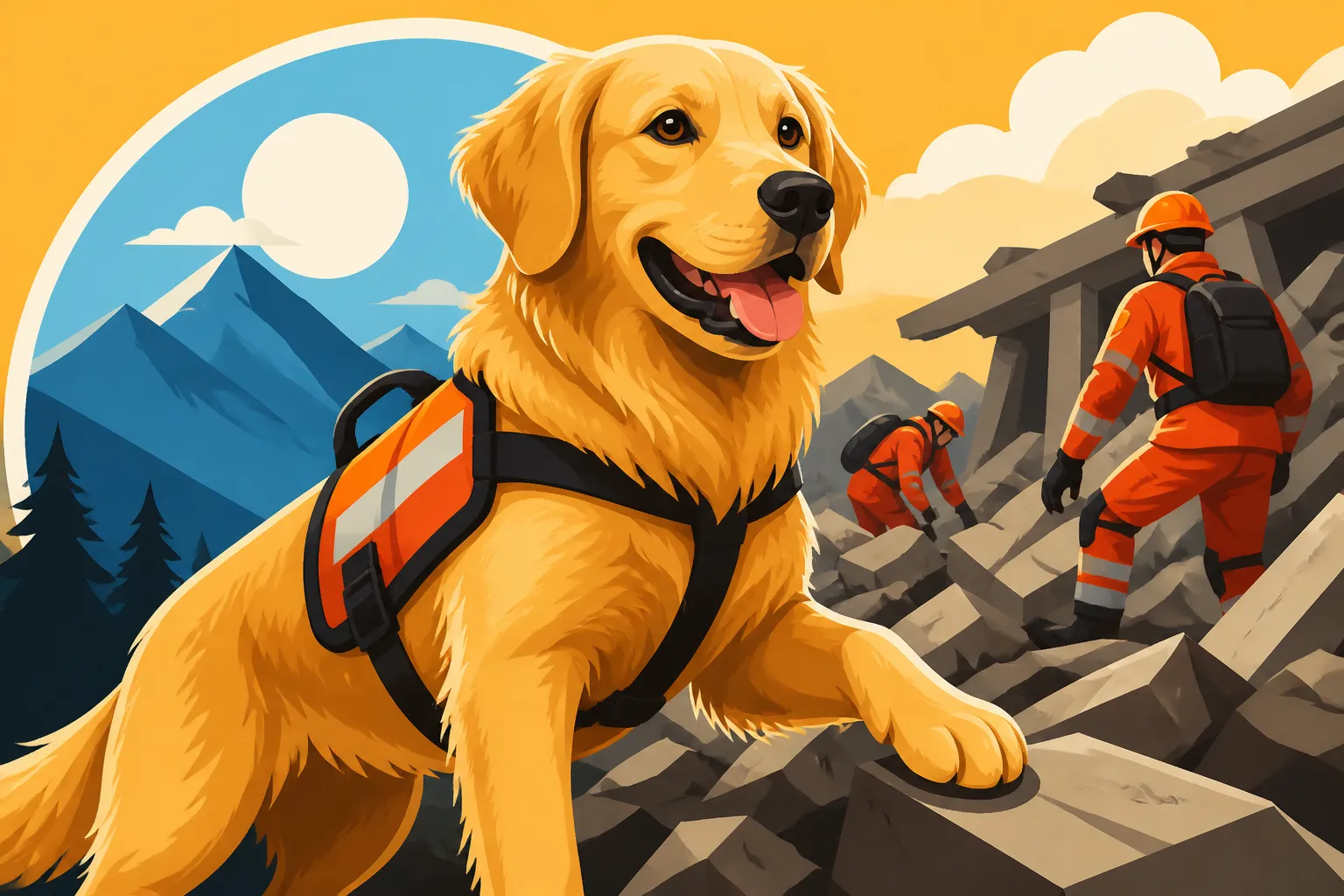
When disaster strikes, whether it's an earthquake, hurricane, or building collapse, Golden Retrievers can be deployed as part of urban search and rescue (USAR) teams. In these highly complex and dangerous environments, Goldens use their agility and keen noses to navigate unstable rubble piles, searching for survivors trapped beneath debris. Their medium size allows them to squeeze into tight spaces, and their gentle nature ensures they won't inadvertently harm a fragile survivor.
Beyond live find, some Golden Retrievers are trained in Human Remains Detection (HRD), often referred to as cadaver dogs. This is incredibly specialized and emotionally challenging work. These dogs can detect the minuscule scent particles associated with human decomposition, even after extended periods or under challenging conditions like deep water or buried remains. Their unwavering focus and precision are invaluable in bringing closure to families. Training for this role is extremely intense, and it takes a very stable dog to perform consistently in such grim circumstances.
Water Rescue and Recovery
Given their heritage as water retrievers and their natural love for swimming, it's no surprise that many Golden Retrievers excel in water search and recovery. They can be trained to detect human scent from bodies submerged underwater, a task that is incredibly difficult for humans and often impossible without specialized equipment. The scent of a person in water rises, and a trained Golden can pinpoint the source from a boat or even swimming alongside a handler.
This ability makes them indispensable in situations involving drownings or water accidents, assisting dive teams by narrowing down search areas significantly. Their strong swimming skills, double coat for insulation, and inherent retrieving instinct mean they are perfectly adapted for sustained work in aquatic environments. From retrieving items dropped in the water to actively searching for individuals, Goldens truly shine when the call of the water is involved. Swimming Safety for Golden Retrievers is always paramount.
| SAR Discipline | Primary Skill Utilized | Typical Environment | Key Golden Retriever Trait |
|---|---|---|---|
| Wilderness Air Scent | General Human Scent | Forests, mountains, open fields | Endurance, keen nose |
| Trailing | Specific Human Scent | Varied terrain, rural/urban borders | Persistence, focus |
| Disaster Site (Live Find) | Live Human Scent | Rubble, collapsed structures, urban | Agility, stable temperament |
| Human Remains Detection | Decomposed Human Scent | Land, water, historical sites | Precision, resilience |
| Water Rescue and Recovery | Submerged Human Scent | Lakes, rivers, oceans | Strong swimmer, water love |
The Rigorous Training Journey for a SAR Golden
Becoming a certified search and rescue team is not a casual endeavor; it requires years of dedicated training for both the Golden Retriever and its handler. This isn't just about teaching a few commands; it's about building an unbreakable bond, honing instincts, and preparing for every conceivable scenario. The process is lengthy, challenging, and emotionally taxing, but the potential to save a life makes every hour worthwhile.
Early Foundations and Socialization
The journey begins in puppyhood, laying a strong foundation of obedience, confidence, and broad socialization. A SAR candidate needs to be bomb-proof – completely comfortable and unfazed by new people, loud noises, strange environments, and different textures underfoot. This means exposing a young Golden Retriever to a huge variety of sights, sounds, and experiences from a very young age, always ensuring positive associations. Socializing a Golden Retriever Puppy is not just a recommendation for SAR dogs, it's a requirement.
Basic obedience is paramount. Commands like "sit," "stay," "come," and "down" must be rock-solid, even in distracting environments. A SAR dog needs to respond instantly to its handler's voice and hand signals, sometimes from a distance. Early "play" often involves scent games, hiding toys, and encouraging their natural retrieving drive, all designed to build excitement for the "find" and to foster that crucial bond between dog and handler. Think about investing in good quality, durable toys from places like Chewy to keep them engaged during this crucial phase.
Advanced Scent Work and Obedience
Once the foundational work is solid, training progresses to advanced scent detection. This involves teaching the Golden to recognize and focus on human scent, distinguishing it from animal scents, and ignoring distractions. Handlers will create increasingly complex search scenarios, starting in controlled environments and moving to real-world locations like abandoned buildings, large fields, or dense woods. The dog learns to indicate a "find" reliably, often with a bark or by returning to the handler with an item.
During this phase, advanced obedience skills are continuously reinforced. Off-leash control becomes critical, as many SAR tasks require the dog to work independently, sometimes out of sight of the handler. The handler also learns crucial skills: reading their dog's body language, understanding scent dynamics (how scent travels), navigation, first aid, and incident command structures. It's a true partnership, where both members are constantly learning and adapting.
Certification and Ongoing Practice
Before a Golden Retriever can officially join a SAR team, they must pass rigorous certification tests. These tests are designed to assess the dog's scenting abilities, obedience, stamina, and the handler's ability to navigate, read their dog, and manage the search. Certification usually involves multiple scenarios under realistic conditions, often blind, meaning the handler doesn't know where the "victim" is hidden.
But certification isn't the end; it's just the beginning. SAR is a perishable skill, and teams must maintain a demanding schedule of ongoing training, practice drills, and continuing education. Regular practice in diverse environments—different weather conditions, times of day, and types of terrain—ensures the Golden Retriever stays sharp and ready for deployment. Many teams practice weekly, dedicating countless hours to maintaining their high level of readiness.
Challenges and Considerations for Golden Retriever SAR Teams
While Golden Retrievers possess many ideal traits for search and rescue, the path to becoming and remaining an effective SAR team is fraught with challenges. It requires immense dedication, physical endurance, and emotional resilience from both the dog and the human handler. Understanding these hurdles is crucial for anyone considering this demanding but incredibly rewarding calling.
Physical Demands and Endurance
Search and rescue operations are physically grueling. SAR Goldens and their handlers must be in peak physical condition to navigate difficult terrain, often for extended periods. This might involve scrambling over rubble, hiking through dense brush, traversing steep hills, or working in extreme weather conditions—be it sweltering heat or freezing cold. The dog's joints and overall health are constantly put to the test. Exercise a Golden Retriever Needs Each Day is a good baseline, but SAR work pushes these limits significantly.
Handlers must also maintain their own fitness, as they need to keep up with their dog and carry essential gear. They are responsible for their dog's well-being on deployments, which includes ensuring proper hydration, nutrition (often carried in specialized packs, and you'll find plenty of options on Chewy), and managing fatigue. A Golden's health, including susceptibility to conditions like Golden Retriever Hip and Elbow Dysplasia Explained, becomes a critical consideration, and handlers must work closely with veterinarians to ensure their dog is fit for the job.
Managing the Emotional Toll
SAR work, especially in disaster or HRD scenarios, can be incredibly emotionally taxing. Handlers witness tragedy, and while dogs are less emotionally affected by the grim reality of a situation, they are highly attuned to their handler's emotions. It's vital for handlers to manage their own stress and grief, as this can directly impact their dog's performance and well-being. Knowing when to step back, seek support, and allow for recovery is paramount.
For the Golden Retriever, while they don't process trauma in the same way humans do, they can still experience stress from prolonged work, loud noises, or intense situations. Handlers must be vigilant for signs of stress or burnout in their dogs, ensuring they have adequate rest, decompression time, and positive reinforcement to maintain their enthusiasm for the work. The goal is to keep the "game" alive for the dog, even when the stakes are incredibly high.
The Commitment of the Handler
Becoming a SAR handler is not a hobby; it's a lifestyle. The time commitment is enormous, encompassing thousands of hours of training, ongoing education, certifications, and deployments that can happen at any time, day or night, and last for days. Handlers often volunteer their time, resources, and often put their personal lives and jobs on hold to respond to emergencies. It takes an individual with profound dedication and selflessness.
This commitment extends to the financial investment as well. While many SAR teams are volunteer-based, handlers bear the costs of their dog's care, specialized equipment (from harnesses and tracking devices to first aid kits), travel to training sessions and deployments, and continuing education. It's a labor of love that demands an incredible amount of personal sacrifice, but the deep satisfaction of knowing you and your Golden Retriever have made a difference in someone's life is, for many, an unparalleled reward. How Big an Emergency Fund a Golden Retriever Needs should include provisions for SAR specific gear and training.
Golden Retrievers, with their exceptional scenting abilities, steadfast temperaments, and unwavering drive to please, are truly extraordinary partners in the field of search and rescue. From tracking lost hikers in vast wildernesses to diligently searching disaster zones or aiding in water recoveries, their contributions are invaluable and often lifesaving. The path to becoming a SAR team is long and arduous, demanding immense dedication, rigorous training, and a profound commitment from both dog and handler. Yet, for those who answer the call, the bond forged and the lives touched make every challenge worthwhile, showcasing the very best of what our remarkable Golden Retrievers have to offer the world.
Disclaimer
This article is for general informational purposes only and does not constitute professional advice. Laws, prices and regulations vary by location and change over time. Consult a qualified professional for guidance on your specific situation.