Golden Retriever Gait and Movement
It's truly a joy to watch a Golden Retriever move – that flowing, effortless trot, the playful bounce, or the determined stride as they follow a scent. But as loving owners, we sometimes worry if that movement looks "right." Maybe you've noticed a slight stiffness after a long nap, or perhaps your puppy seems a bit clumsy on their feet, leaving you wondering what's normal and what might be a cause for concern. This guide is here to demystify the Golden Retriever's gait and movement, helping you understand what a healthy, happy Golden looks like in motion and how to keep them moving well throughout their lives.
Understanding the Golden Retriever's Ideal Gait
A Golden Retriever in motion is a beautiful thing to behold, a testament to centuries of careful breeding for a specific purpose. Their gait isn't just about getting from point A to point B; it's a reflection of their underlying structure, health, and heritage.
The Breed Standard's Vision of Movement
If you've ever watched a dog show, you'll know that gait is a huge part of how a Golden Retriever is judged. The breed standard, whether from the American Kennel Club (AKC) or other organizations, describes an ideal movement that is both efficient and graceful. They talk about a "smooth, free, graceful, powerful, and well-coordinated gait" with "good reach and powerful drive." This isn't just fancy language; it describes a dog that can work all day in the field, tirelessly retrieving game without wasting energy.
Think about what a Golden was bred to do: sprint through tall grass, dive into cold water, and carry birds softly in their mouth. To do this effectively, they needed a body that could move with incredible stamina and agility. Their movement should look effortless, almost as if they're gliding, even though they're putting immense power into each stride. This perfect blend of reach from the front and drive from the rear ensures that they cover ground efficiently, keeping their body in balance and minimizing stress on their joints. Any deviation from this ideal can sometimes hint at underlying structural issues, which is why it’s so important for breeders to pay close attention to the Health Clearances a Golden Retriever Breeder Must Show for the parents.
Key Characteristics of a Healthy Golden Gait
When we talk about a healthy Golden gait, we're really looking at how all parts of their body work together in harmony. It's a symphony of controlled power and elegant flow.
- Forequarters: The front legs should have excellent "reach." This means they extend well forward, allowing the dog to cover a lot of ground with each step. The shoulder assembly should be well-angulated, allowing for this fluid extension. When viewed from the front, the legs should track straight, without any inward or outward deviation, and the paws should land directly in line with the body.
- Hindquarters: This is where the "drive" comes from. The powerful muscles of the hind legs and thighs should propel the dog forward with strength. The hocks (what looks like the ankle joint on a dog's back leg) should flex well and push off with purpose. From behind, the hind legs should also track straight, neither too close together (cow-hocked) nor too wide apart, with no wobbling. The overall impression should be one of strength and propulsion, making their movement seem almost like a smooth piston action.
- Topline: A Golden's back (or topline) should remain level and steady while they move. You shouldn't see excessive bouncing or rolling. A steady topline indicates good core strength and a sound spinal structure, allowing the power from the hindquarters to transmit efficiently through the body.
- Head and Tail Carriage: While not directly contributing to locomotion, the way a Golden carries their head and tail completes the picture of a healthy gait. Their head should be carried proudly but naturally, in proportion to their stride. The tail should be carried "level with or with a slight upward curve," as the standard says, not tucked tightly or excessively high. It acts as a natural counterbalance, especially when turning or picking up speed. It’s all part of that beautiful, balanced picture.
Common Gaits: Walk, Trot, and Gallop
Dogs, like humans, have different ways of moving depending on their speed and purpose. For Golden Retrievers, understanding these different gaits helps us appreciate their athleticism and spot any potential deviations.
The Elegant Trot
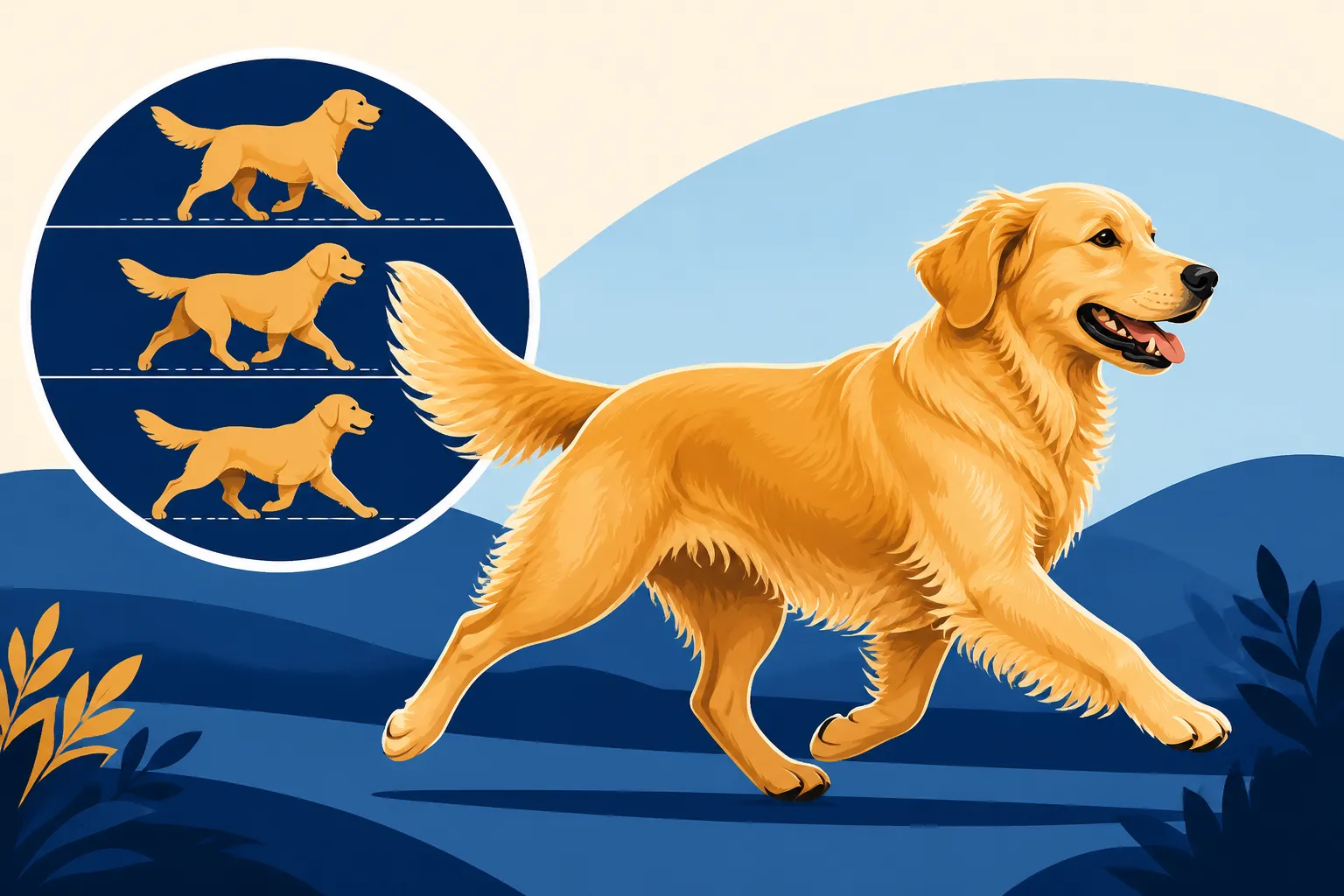
For most owners, the trot is the gait you’ll observe most often when your Golden is moving at a brisk pace or out on a walk. This is a two-beat diagonal gait, meaning that the diagonally opposite pairs of legs (e.g., left front and right rear) move forward and backward at the same time. It’s often considered the most efficient gait for a dog covering moderate distances and is the preferred gait for evaluation in dog shows because it clearly showcases structure and balance.
When a Golden trots, their movement should appear rhythmic, balanced, and ground-covering. From the side, you should see that excellent reach from the front legs and powerful drive from the rear, with the dog's body staying level and steady. There should be a sense of purpose and endurance in their strides. Observing them from the front or rear, their legs should move like parallel lines, neither crossing over nor swinging out. Any deviation from this, such as legs flinging out to the side or feet turning inward, could indicate a structural issue or pain. It's a gait that truly highlights the breeding behind their functional design.
The Leisurely Walk and Powerful Gallop
While the trot is key for sustained movement, Goldens use other gaits for different situations, each revealing something unique about their physique.
The walk is a four-beat gait, meaning each of the four legs lifts and lands independently. It's the slowest gait, deliberate and used for exploring, sniffing, or simply moseying along. Even at a walk, a Golden's underlying strength and balance should be evident. Their head might be down, sniffing, but their body should still move fluidly, with a gentle shifting of weight. You shouldn't see any obvious dragging of paws or stiffness that would impede a casual stroll. A comfortable, easy walk is the foundation for all other movements.
The gallop is the fastest gait, a powerful bounding movement used for bursts of speed during play or when chasing something exciting. It's a four-beat symmetrical gait where the dog literally springs off the ground, with both hind legs powering the push-off and both front legs absorbing the landing. While Goldens certainly can gallop, you'll see this less often than a trot in their day-to-day activities unless they're really letting loose in an open field, perhaps chasing a ball or another dog. It's an impressive display of their athleticism, showing explosive power. It’s important, especially for younger dogs, not to overdo high-impact galloping on hard surfaces, as this can put stress on developing joints. Forced Exercise and Golden Retriever Growth Plates are sensitive when they're young, and moderation is key.
What to Look For: Signs of Good and Concerning Movement
As observant Golden Retriever owners, we become finely attuned to our dog's habits, and that includes their movement. Knowing what to look for, both good and potentially problematic, can help you address concerns early.
Hallmarks of a Well-Structured Golden
A Golden Retriever with excellent structure will exhibit a harmonious, efficient gait. This isn't just about winning ribbons in the show ring; it's about a dog that can live an active, comfortable life with minimal joint strain. You'll notice that their paws land squarely, pointing forward, with no rolling inward or outward. When trotting, their front and hind legs should track in straight lines, giving a sense of purpose and direction to their movement. The back should stay stable, without any noticeable dip or arch that doesn't belong.
Think about the fluidity. There should be no hesitation, no sudden jolts, just a smooth, continuous flow of motion. Their joints should appear flexible, bending and extending through their full natural range, without appearing loose or wobbly. A well-conditioned Golden will move with endurance and athleticism, reflecting healthy muscles, ligaments, and tendons supporting their bone structure. This overall picture allows them to maintain a Keeping a Golden Retriever at a Healthy Weight and enjoy long, active lives.
Red Flags in a Golden Retriever's Gait
Unfortunately, Goldens are prone to certain orthopedic issues, and sometimes the first sign is a subtle change in their movement. Being vigilant can make a huge difference in their long-term comfort and health.
- Lameness or Limping: This is perhaps the most obvious red flag. Any consistent favoring of a leg, even a slight skip or hop, warrants attention. It could be something minor like a thorn in a paw pad or a pulled muscle, or something more serious like a fracture or a developing joint condition. Don't ignore it.
- Stiffness: You might notice your Golden is stiff after getting up from a nap, especially in the morning. They might take a few steps slowly before loosening up. This is a common sign of arthritis, particularly in older dogs. Arthritis Signs in an Eight-Year-Old Golden often manifest this way, and while it's part of aging, there are many ways to manage it.
- Bunny Hopping: This distinctive gait involves a dog using both hind legs simultaneously to push off, rather than alternating them. It often looks like a bunny hopping. It's a classic symptom of hip dysplasia, as the dog tries to minimize discomfort by moving their hips together. If you see your Golden doing this, especially at a trot or canter, it's definitely time for a vet visit. You can learn more about The Bunny Hopping Gait in Golden Retrievers and what it indicates.
- Crabbing or Sidewinding: This is when a dog doesn't track straight but moves at an angle, with their body slightly twisted. While some dogs naturally "crab" a little, if it's new or extreme, it could point to spinal issues, hip pain, or an imbalance.
- Short Striding: A lack of full extension in either the front (reach) or rear (drive) legs. The dog appears to take smaller, choppier steps. This can indicate pain in the shoulders, elbows, hips, or knees, limiting their range of motion.
- Hitching or Skipping: An irregular, jerky movement, most commonly seen in a hind leg, where the leg might appear to pause or lift higher than usual before landing. This can suggest luxating patella (kneecap dislocation) or other knee issues.
- Reluctance to Move: Beyond gait changes, a general unwillingness to jump into the car, climb stairs, or engage in their usual Exercise a Golden Retriever Needs Each Day can be a huge indicator that something is amiss. Signs a Golden Retriever Is in Pain can be subtle, and a change in activity level is a big one. These are important observations to share with your veterinarian.
Factors Influencing Golden Retriever Movement
A Golden Retriever's movement is a complex interplay of genetics, development, age, and lifestyle. Understanding these factors can help owners provide the best care.
Genetics and Early Development
When it comes to movement, the genetic hand your Golden is dealt plays an enormous role. Golden Retrievers are unfortunately predisposed to certain orthopedic conditions that can significantly impact their gait.
Hip and Elbow Dysplasia are arguably the most well-known and prevalent issues. Hip dysplasia is a malformation of the hip joint, where the ball and socket don't fit together properly, leading to looseness and eventually arthritis. Elbow dysplasia is a similar condition affecting the elbow joint. Both can cause pain, stiffness, and noticeable changes in gait, like the aforementioned bunny hopping or a reluctance to extend limbs fully. Golden Retriever Hip and Elbow Dysplasia Explained delves deeper into these conditions, but it's crucial to understand how they manifest in everyday movement.
Another condition, Osteochondritis Dissecans (OCD), involves abnormal cartilage development in the joints, often the shoulders or elbows, and can also lead to lameness. This is why the importance of choosing a reputable breeder who performs Health Clearances a Golden Retriever Breeder Must Show cannot be overstated. These clearances aim to reduce the incidence of such inheritable conditions in puppies.
Beyond genetics, a puppy's early development is critical. Rapid growth, particularly if a puppy is overfed or on an inappropriate diet, can put stress on developing bones and joints. This is why feeding a large breed puppy food designed for slow, steady growth is so vital. Over-exercising a puppy, especially with high-impact activities like long runs or excessive jumping, before their When a Golden Retriever's Growth Plates Close can also contribute to future orthopedic problems. These growth plates are delicate and need time to mature properly.
Age, Weight, and Conditioning
Life stages, body weight, and physical conditioning all have a profound impact on a Golden's ability to move freely and comfortably.
- Puppies: Young Goldens are often clumsy and uncoordinated. They go through gangly growth spurts where their body proportions seem to change overnight, making their gait look a bit awkward. This is usually normal. However, it's also a crucial time to monitor for early signs of pain or limping that might indicate a developing orthopedic issue. Golden Retriever Puppy Feeding Amounts and Schedule needs to be carefully managed to prevent overly rapid growth.
- Adolescents: As Goldens enter their "teenage" phase (roughly 6 months to 2 years), they are often full of energy but may still be a bit uncoordinated as their bodies finish filling out and muscles develop. Their movement will become more refined as they mature.
- Adults: A healthy adult Golden Retriever, typically between 2 and 7 years old, should exhibit the ideal, effortless gait described in the breed standard. This is their peak physical performance.
- Seniors: As Goldens age, just like humans, they are prone to developing arthritis and general stiffness. Their gait may become slower, more deliberate, and less fluid. They might struggle with stairs or jumping. Caring for a Senior Golden Retriever involves adapting exercise and environment to accommodate these changes.
- Weight: Carrying extra pounds puts immense stress on a Golden Retriever's joints, accelerating the onset and severity of conditions like arthritis and hip dysplasia. Even a few extra pounds can significantly alter their gait, making them less agile and causing discomfort. You can learn more about How Extra Weight Shortens a Golden Retriever's Life and the serious impact it has.
- Conditioning: Good muscle tone and core strength are essential for supporting the joints and maintaining a healthy gait. Regular, appropriate exercise helps build and maintain these muscles, contributing to overall physical well-being. A well-conditioned Golden will move more efficiently and with greater ease than one who is out of shape. Providing them with opportunities for activities like Swimming as Exercise for a Golden Retriever can build muscle with less impact on joints.
| Gait Characteristic | Healthy Golden Retriever | Concerning Golden Retriever |
|---|---|---|
| Overall Impression | Smooth, fluid, graceful, effortless, powerful | Stiff, jerky, hesitant, uncoordinated, unbalanced |
| Reach & Drive | Good extension of front legs, strong push from hind | Short, choppy strides; lack of extension; weak propulsion |
| Foot Placement | Paws land straight, in line with body; no dragging | Paws splay, turn in/out; scuffing/dragging of feet |
| Topline (Back) | Level, stable, no excessive bounce or sway | Dipping, arching, or excessive movement in the back |
| Hind Legs (Rear View) | Track parallel, strong hock flexion, no crossing | Cow-hocked (hocks too close), bow-legged, crossing over |
| Front Legs (Front View) | Track parallel, no inward/outward deviation | Paws splay or turn in/out; crabbing (moving sideways) |
| Signs of Pain/Discomfort | Alert, engaged, eager to move | Limping, stiffness after rest, reluctance to move, bunny hopping |
| Activity Level | Enjoys walks, runs, playing; recovers well | Avoids stairs/jumping, tires easily, slow to get up |
Maintaining Healthy Movement Throughout Life
Ensuring your Golden Retriever maintains healthy movement isn't just about spotting problems; it's about proactive care throughout their life. From what they eat to how they play, every decision contributes to their joint health and overall mobility.
Nutrition and Supplements
A foundational element of healthy movement starts with what's in their food bowl. Proper nutrition provides the building blocks for strong bones, healthy joints, and resilient connective tissues.
For puppies, choosing a high-quality Large Breed Puppy Food and Why Goldens Need It is critical. These formulas are specifically designed to promote slower, steady growth, preventing the rapid growth spurts that can exacerbate developmental orthopedic diseases. Look for appropriate calcium and phosphorus levels. As they mature, maintaining a balanced adult diet tailored to their activity level is essential. You want food that provides good quality protein for muscle maintenance and a healthy balance of fats and carbohydrates for energy without contributing to excessive weight gain. You can find a wide selection of specialized diets and supplements on platforms like Chewy, making it easier to match your dog’s specific needs.
Beyond diet, certain supplements can play a supportive role, especially as your Golden ages or if they have a known joint condition. Glucosamine and chondroitin are popular choices, believed to support cartilage health and reduce inflammation. While not a cure-all, many owners report seeing benefits. Glucosamine Doses for a Golden Retriever vary by weight, so always discuss with your vet first. Omega-3 fatty acids, found in fish oil, are also excellent for their anti-inflammatory properties, which can help reduce joint pain and improve coat health. Remember, supplements are just that – supplements – and should always be discussed with your veterinarian to ensure they are appropriate and won't interact with any other medications your Golden might be on. Perhaps most importantly, consistently maintaining a Keeping a Golden Retriever at a Healthy Weight is paramount, as extra pounds are brutal on their joints.
Exercise, Environment, and Veterinary Care
Beyond diet, how your Golden lives their life, from daily exercise to their home environment and regular vet visits, all significantly impacts their mobility.
Appropriate exercise is key. Goldens are active dogs, and regular activity helps build and maintain strong muscles that support their joints. This includes daily walks, fetch in the yard, and especially low-impact activities like Swimming as Exercise for a Golden Retriever, which provides excellent cardiovascular and muscle conditioning without stressing joints. However, exercise must be appropriate for their age and condition. Puppy joints are still developing, so Forced Exercise and Golden Retriever Growth Plates should be avoided. For senior Goldens, shorter, more frequent walks are often better than one long, strenuous outing. Listening to your dog and adjusting their activity is crucial.
Your home environment also plays a role. Slippery floors can be challenging for dogs, especially those with developing or arthritic joints, leading to slips and falls that can cause injury or worsen existing conditions. Consider runners or rugs in high-traffic areas. For older Goldens who struggle with jumping into cars or onto furniture, providing ramps or steps can make a huge difference in their comfort and safety. You can find excellent options for Do Golden Retriever Puppies Need Ramps? which can also be adapted for seniors.
Finally, regular veterinary care is non-negotiable. Why Goldens Need Vet Visits Twice a Year is a common recommendation, particularly as they age, to catch any subtle changes or developing issues early. Your vet can perform thorough orthopedic exams, recommend diagnostic imaging like X-rays if needed, and discuss pain management options, anti-inflammatory medications, or even refer you to specialists for things like physical therapy. Physical therapy can be incredibly beneficial for Goldens with hip or elbow issues, providing targeted exercises to strengthen supporting muscles and improve range of motion. If your Golden is diagnosed with a condition like hip dysplasia, exploring Physical Therapy for a Golden Retriever With Bad Hips could significantly improve their quality of life. Many vets work with or can recommend products and therapies available through trusted retailers like Chewy, ensuring continuity of care from diagnosis to daily management.
Disclaimer
This article is for general informational purposes only and does not constitute professional advice. Laws, prices and regulations vary by location and change over time. Consult a qualified professional for guidance on your specific situation.