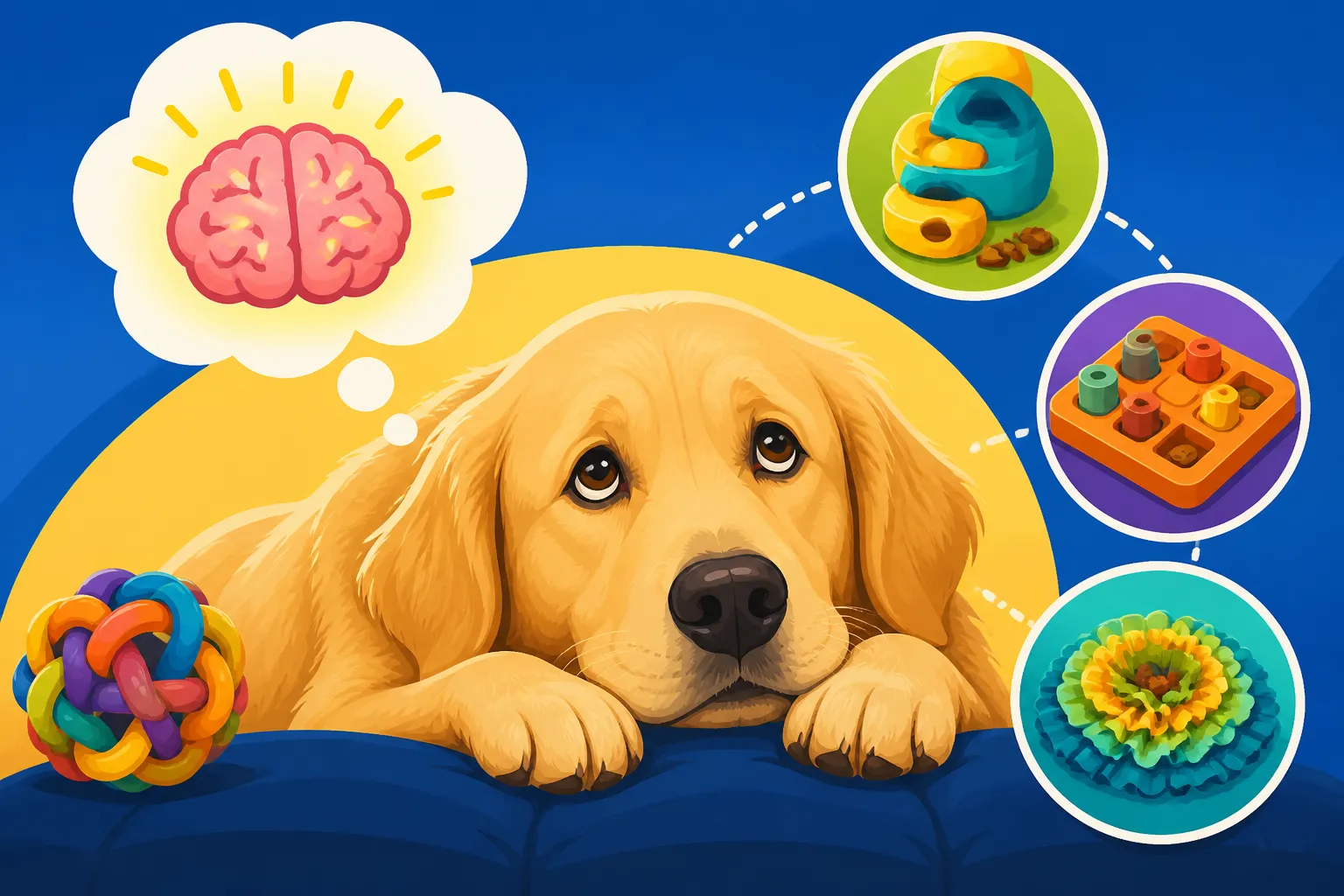
Mental Enrichment for a Bored Golden Retriever
One of the most common complaints I hear from Golden Retriever owners is about their dog's boundless energy, often manifesting as destructive chewing, incessant barking, or general restlessness, even after a long walk. The truth is, many of these behaviors stem not just from a lack of physical exercise, but from a deeply unmet need for mental stimulation. This guide is here to help you unlock your Golden's incredible mind and channel that smart, eager-to-please energy into enriching activities that will make them a happier, calmer companion.
Understanding Why Golden Retrievers Get Bored
Golden Retrievers are more than just pretty faces and wagging tails; they're intelligent, problem-solving dogs originally bred for demanding work. Their ancestors spent hours retrieving game, navigating complex terrains, and making decisions. This history has ingrained a deep need for purpose and mental engagement that a simple walk around the block often can't satisfy. When these cognitive needs aren't met, that brilliant Golden brain can quickly turn to mischief to create its own entertainment.
The Golden Retriever's Innate Drive for Work
Think about the breed's origins. Lord Tweedmouth, who developed the Golden Retriever, sought a dog with a "soft mouth" for retrieving waterfowl and game birds without damaging them. This wasn't just about speed or strength; it required discernment, focus, and a keen sense of smell. These dogs had to remember where fallen birds landed, traverse varied landscapes, and ignore distractions – all highly demanding mental tasks. Today's Golden Retriever still carries that inherent desire to "work" and please, even if their "job" is now to retrieve your slippers instead of a pheasant.
Their drive to retrieve is perhaps the most obvious manifestation of this. It's not just about chasing a ball; it's the entire sequence: watching, tracking, finding, picking up gently, and bringing it back. Each step is a mini-problem to solve, especially in varying environments. Without outlets for this natural intelligence, many Goldens become bored, often exhibiting behaviors like excessive chewing on household items, digging in the yard, or even demanding attention through barking or nudging, simply because their brains are underutilized.
This need for a "job" extends beyond just retrieving. Golden Retrievers thrive on routine, learning, and interaction. They want to be part of what you're doing and contribute. Ignoring this profound aspect of their breed can lead to a dog who seems perpetually restless, even when physically tired. Understanding this foundational drive is the first step toward providing truly fulfilling mental enrichment. You're not just distracting them; you're fulfilling an ancient, ingrained need.
Signs Your Golden Retriever is Understimulated
It’s easy to misinterpret a bored Golden. You might think they're just being a "bad dog," when in reality, they're sending clear signals that their brain needs more engagement. Common signs include destructive chewing, often targeting inappropriate items like furniture legs, remote controls, or shoes, instead of their own toys. This isn't usually malicious; it's an attempt to relieve boredom and expend mental energy through an activity that involves their mouth and senses.
Another red flag is excessive barking, especially if it seems to be at nothing in particular, or if it's a persistent "demand bark" for attention or play. This can be their way of saying, "Hey, I'm bored! Entertain me!" Digging in the yard, chasing shadows, or even becoming hyper-focused on mundane household noises can also indicate a lack of mental outlet. A truly understimulated Golden might also appear lethargic or withdrawn, not because they're tired, but because they're feeling a lack of purpose and joy.
Consider your Golden's daily routine. If it primarily consists of eating, sleeping, and a few walks, but lacks dedicated problem-solving or learning time, these behaviors are likely to emerge. It's not about being "stubborn" or "disobedient" in many cases; it's a frustrated dog trying to entertain themselves in the absence of more appropriate, owner-directed mental activities. Addressing these behaviors with mental enrichment rather than just correction can yield much better, and more humane, results.
The Difference Between Physical and Mental Fatigue
Many Golden Retriever owners make the mistake of thinking that physical exercise alone is enough to tire out their dog. While Goldens absolutely need plenty of physical activity—long walks, runs, swimming, or vigorous games of fetch—this only addresses one part of their energy equation. A physically exhausted Golden might sleep more, but if their brain hasn't been engaged, they can still wake up feeling restless and ready for trouble. This is why you might have a Golden who just ran five miles with you, only to immediately start tearing up the mail. Their body is tired, but their mind is still buzzing.
Mental fatigue, on the other hand, comes from challenging a dog's cognitive abilities, requiring them to think, solve problems, and concentrate. This kind of work can be far more tiring than physical exertion. Think of it like this: you can run a marathon, but you'll still be able to do a crossword puzzle afterwards. However, after an intense day of problem-solving at work, your body might not be tired, but your brain is utterly fried, and all you want to do is relax. Dogs are similar. Just 15-20 minutes of dedicated mental work can sometimes tire a Golden Retriever more effectively than an hour of walking.
Combining both types of stimulation is key to a well-adjusted Golden. A good balance might involve a brisk morning walk, followed by a short puzzle feeder session, some training practice in the afternoon, and a quiet sniff walk in the evening. Understanding that both physical and mental needs must be met, and that they are distinct, is crucial for preventing boredom and fostering a calm, happy dog. Don't underestimate the power of brain games to create a truly content canine.
Interactive Toys and Puzzle Feeders
Interactive toys and puzzle feeders are absolute game-changers for mental enrichment, especially for a breed as smart and food-motivated as the Golden Retriever. These aren't just "toys"; they are tools designed to engage your dog's problem-solving skills, rewarding them for figuring things out. They mimic the natural challenge of foraging for food, turning mealtime or treat time into a mentally stimulating activity rather than a quick gobble.
Food-Dispensing Puzzles for Every Skill Level
Puzzle feeders come in a huge variety, from simple roll-and-dispense toys to complex multi-step puzzles. For a beginner Golden Retriever, start with something straightforward, like a classic KONG filled with peanut butter or plain yogurt and frozen, or a simple ball that drops kibble as it rolls. These introduce the concept of "work for food" without too much frustration. As your Golden gets the hang of it, you can gradually increase the difficulty. You can find a vast selection of these on Amazon, offering different challenge levels.
Intermediate puzzles might involve multiple compartments, sliding doors, or removable pieces that your Golden needs to manipulate with their nose or paws to access treats. Think about wooden puzzles with pegs or flip-tops. The key is to challenge them without making it impossible. If your Golden gives up quickly, the puzzle might be too hard, or they might be getting frustrated. Make sure the reward is enticing enough to keep them motivated. You'll be amazed at how quickly they learn to master these, often developing strategies of their own.
Advanced puzzles often require sequences of actions, like pushing a lever, then sliding a door, then lifting a cup. Some even incorporate different textures or materials. These are fantastic for highly intelligent Goldens who quickly conquer easier puzzles. Remember to supervise your dog, especially with new puzzles, to ensure they don't chew on or ingest pieces. Regularly rotating puzzles also keeps them fresh and exciting, preventing your Golden from simply memorizing the solution.
Durable Chew Toys with Hidden Rewards
Golden Retrievers love to chew, and providing appropriate outlets for this natural behavior is essential. But you can make chewing even more mentally stimulating by incorporating hidden rewards. Beyond the basic KONG, there are many durable rubber toys designed to be stuffed with treats, peanut butter, or even a portion of their meal. The act of licking, gnawing, and working to extract the food is incredibly satisfying and mentally engaging for a Golden.
Look for toys made from tough, food-grade rubber that can withstand your Golden's strong jaws. Some brands offer different strengths of rubber, so choose one appropriate for a powerful chewer. You can stuff these with wet dog food, plain Greek yogurt, pumpkin puree, or even a mix of kibble soaked in broth. Freezing them makes the challenge last even longer, providing extended mental engagement, which is perfect for when you need your Golden to settle down for a while.
These types of chew toys not only provide mental stimulation but also help redirect inappropriate chewing behaviors. If your Golden is always seeking out your shoes, offering a stuffed, frozen chew toy can satisfy that oral fixation in a much more acceptable way. Plus, the licking and chewing action can be very calming and stress-relieving for dogs, making them excellent tools for quiet time or even mild Separation Anxiety in Golden Retrievers. Always ensure the toy is appropriately sized for your Golden to prevent choking hazards.
DIY Puzzle Solutions Using Household Items
You don't always need to buy expensive toys to provide mental enrichment. Many household items can be repurposed into engaging puzzles for your Golden Retriever. This is a fantastic way to introduce the concept of brain games without a big investment, and it allows for endless creativity. Just make sure whatever you use is safe, non-toxic, and can't be easily ingested.
A classic DIY puzzle is the "muffin tin game." Place treats or kibble in some of the muffin tin cups, and then cover all the cups with tennis balls. Your Golden will need to remove the balls to find the hidden treasures. This simple game encourages nose work and problem-solving. Another easy option is to scatter kibble across a towel, roll it up tightly, and then tie a knot in it. Your Golden has to unroll and untangle the towel to get their meal.
For a bit more challenge, you can use cardboard boxes. Place treats inside smaller boxes, then put those smaller boxes into a larger one, perhaps with some crumpled newspaper or empty paper towel rolls as obstacles. Your Golden will love tearing apart the cardboard to get to the prize, satisfying their natural urge to shred (on appropriate items!). Always supervise DIY puzzles, especially those involving cardboard, to make sure your dog isn't eating too much of the material. These DIY activities are a fun way to engage your Golden's brain and bond with them.
Engaging Their Natural Instincts: Scent Work and Retrieving
Golden Retrievers possess an incredible sense of smell and a deep-seated desire to retrieve. Tapping into these natural instincts provides some of the most rewarding and mentally exhausting enrichment opportunities. It's not just about a game; it's about fulfilling their biological blueprint.
Introduction to Scent Games at Home
Scent work, often called "nose work" or "canine scent detection," is one of the best ways to mentally tire out a Golden Retriever. Their noses are hundreds of times more sensitive than ours, and allowing them to use this superpower is incredibly satisfying for them. You can start with simple hide-and-seek games right in your living room. Begin by showing your Golden a high-value treat, then hide it in an obvious spot while they watch. Say "find it!" and let them go. Praise them enthusiastically when they succeed.
As they get the hang of it, gradually increase the difficulty by hiding treats in less obvious places, under a cushion, behind a curtain, or in another room, while they are not watching. Start with just one room, then expand to others. The goal is for them to use their nose, not their eyes, to locate the treat. You can use different types of treats to keep it interesting – some smelly, some crunchy. This type of mental work is surprisingly exhausting for dogs because it requires intense concentration and problem-solving, much like a human trying to solve a complex puzzle.
Consider investing in a snuffle mat, which is a fabric mat with many folds and pockets designed to hide kibble or treats. Your Golden has to root around with their nose to find the food, which is a fantastic way to engage their foraging instincts and provide a slow, mentally stimulating meal. Snuffle mats are readily available on Amazon and offer a great introductory experience to scent work, making mealtime a brain game rather than just a quick gobble.
Advanced Scent Challenges and Community Classes
Once your Golden is a pro at home scent games, you can take their nose work skills to the next level. This can involve hiding multiple treats in a designated "search area" in your yard or house, requiring them to clear the entire space. You can also introduce "target odors" – specific scents that your dog learns to identify and indicate. This is often done using essential oils like birch, anise, or clove, which are used in competitive nose work.
Many communities offer scent work classes through local dog clubs or training facilities. These classes provide structured learning, often using professional-grade equipment and teaching methods. Your Golden will learn to search specific containers, vehicles, or even large outdoor areas for hidden target odors. The benefits go beyond just mental stimulation; scent work builds confidence, strengthens your bond with your dog, and can even help shy or reactive dogs focus on a task rather than their environment.
Competitive nose work (through organizations like NACSW or AKC Scent Work) allows dogs and owners to test their skills and earn titles. Even if you never compete, the process of learning and practicing advanced scent challenges with your Golden is incredibly enriching for both of you. It's a fantastic way to tap into their primal instincts and give them a "job" that is both fun and deeply satisfying. This high-level mental engagement can lead to a much calmer and more contented Golden Retriever at home.
Rethinking Fetch: Making Retrieving More Mentally Stimulating
For most Golden Retrievers, fetch is a beloved pastime. But simply throwing a ball repeatedly, while good for physical exercise, can become monotonous and isn't particularly mentally challenging. We can elevate fetch from a purely physical activity to a brain game by adding layers of complexity. This taps into their intelligent retrieving instinct in a more profound way.
Instead of just throwing the ball, try hiding it first. Tell your Golden to "stay" (or put them in another room), hide the ball in a semi-obvious spot (under a bush, behind a tree, in tall grass), then release them with a "find it!" command. This turns fetch into a mini-scent game, forcing them to use their nose and problem-solving skills to locate the toy before retrieving it. You can gradually increase the difficulty of the hiding spots.
Another way to make retrieving more mentally stimulating is to incorporate impulse control and obedience. For example, make them "wait" or "stay" for a longer period before you throw the ball. Teach them to retrieve specific items by name ("get the red ball," "find the duck"). You could even set up an "obstacle course" where they have to navigate around objects to retrieve the item, or practice retrieving from different textures like water or mud. The BAXTER & Bella Online Puppy School also has excellent resources for teaching advanced retrieving and impulse control, building on a Golden's natural abilities in a structured way. This turns a simple game into a rewarding mental exercise.
Learning New Skills and Reinforcing Old Ones
Golden Retrievers are renowned for their intelligence and eagerness to please, making them fantastic students. Dedicated training sessions aren't just about obedience; they're powerful mental workouts that build confidence, strengthen your bond, and provide a valuable outlet for their smart brains. Even just 10-15 minutes of focused training a few times a day can make a huge difference in your Golden's overall demeanor.
The Power of Positive Reinforcement Training
Positive reinforcement training is hands-down the most effective and humane method for training Golden Retrievers. This approach focuses on rewarding desired behaviors, making it more likely your dog will repeat them. For a breed that thrives on pleasing its owner and is highly food-motivated, positive reinforcement is incredibly powerful. It turns learning into a fun game rather than a chore, engaging their minds in a joyful way.
When you use positive reinforcement, you're not just teaching commands; you're teaching your Golden to think. They learn to offer behaviors, experiment, and figure out what earns them a reward. This process of active learning and problem-solving is intensely mentally stimulating. Short, frequent training sessions (5-10 minutes) are often more effective than one long, drawn-out session, as they keep your Golden engaged and prevent mental fatigue or boredom.
This method also significantly strengthens the human-canine bond. Your Golden learns to associate you with good things, making them more attentive and eager to interact. It builds trust and makes them a more willing participant in all aspects of their lives, from vet visits to new enrichment games. Programs like the BAXTER & Bella Online Puppy School are built on positive reinforcement principles and offer comprehensive guides for teaching a wide range of skills to your Golden, fostering their natural desire to learn and engage.
Teaching "Thinking" Commands and Tricks
Beyond basic obedience, teaching your Golden Retriever complex commands and fun tricks offers a fantastic mental workout. These aren't just parlor tricks; they require focus, coordination, and a deeper level of understanding. Think about commands like "go find your leash," "put your toys away," or "bring me the remote." These commands require your Golden to identify specific objects and perform a sequence of actions.
Tricks like "roll over," "play dead," "weave through your legs," or "bow" demand a lot of brainpower. They break down a larger action into smaller steps, which your Golden has to learn and string together. The process of learning these multi-step tricks is incredibly enriching. It forces them to concentrate, remember sequences, and refine their motor skills. Plus, the joy and pride your Golden exhibits when they successfully perform a new trick is truly heartwarming.
The beauty of teaching tricks is that there's no limit to what you can teach. You can combine existing commands or create entirely new ones. This ongoing learning process keeps your Golden's mind sharp and prevents boredom. It's a wonderful way to interact, build a deeper connection, and give your intelligent companion a regular mental challenge that taps into their problem-solving abilities. Don't be afraid to get creative with your training; your Golden will likely surprise you with how quickly they pick things up.
Advanced Obedience and Canine Sports
For Goldens who excel at basic and intermediate training, advanced obedience and canine sports offer the ultimate mental and physical challenge. These activities push your Golden's capabilities to their limits, demanding intense focus, precision, and teamwork. They are not only incredibly fun but also provide unparalleled mental enrichment, making them ideal for highly intelligent and energetic Golden Retrievers.
Consider delving into competitive obedience, where dogs perform a routine of commands off-leash with exact precision. This requires incredible focus and a strong bond with the handler. Rally obedience is a more relaxed version, with a course of stations where dogs and handlers perform different commands. These activities demand sustained mental effort and teach your Golden to perform under various distractions.
Beyond obedience, there's a whole world of canine sports:
- Agility: Navigating obstacle courses with tunnels, jumps, and weave poles. This requires speed, coordination, and mental mapping.
- Dock Diving: A retrieving sport where Goldens jump off a dock into water to retrieve a toy. This combines their love for water and retrieving with a physical challenge.
- Canine Freestyle (Musical Canine Sports): Performing choreographed routines to music, combining obedience moves with creative tricks.
- Tracking and Trailing: Following a scent trail left by a person, mimicking their natural desire to use their nose.
These sports offer structured ways to engage your Golden's body and mind, providing consistent mental challenges and a sense of accomplishment. They also offer a fantastic social outlet for both you and your dog. You might find a local club or a trainer specializing in these sports, which can introduce you to a vibrant community of passionate dog owners. Golden Retriever Obedience Titles and Sports is a great resource if you're curious about where to start.
Incorporating Mental Enrichment into Daily Routines
Mental enrichment doesn't have to be a separate, scheduled activity that takes up hours of your day. The most effective approach is to weave it seamlessly into your Golden Retriever's daily routine, transforming mundane moments into opportunities for brain engagement. Small, consistent efforts throughout the day can add up to a significant impact on your dog's happiness and calmness.
Morning Brain Games to Start the Day Right
Starting the day with some mental stimulation can set a positive tone for your Golden Retriever, making them more settled and less prone to seeking out their own, potentially destructive, entertainment later. Instead of simply putting their breakfast bowl down, turn mealtime into a brain game. Use a puzzle feeder for their morning meal or scatter their kibble around the house or yard for them to "forage" for. This taps into their natural instincts and makes them work for their food, which is inherently satisfying.
Another great morning activity is a short, focused training session. Just 5-10 minutes of practicing known commands, or introducing a new simple trick, can engage their brain effectively. You could also do a quick game of "find it" with their favorite toy, hiding it while they're not looking and letting them sniff it out. These activities provide mental exercise before their physical exercise, helping to burn off that morning "zoomie" energy in a constructive way.
The goal is to provide a sense of purpose and accomplishment early in the day. A Golden Retriever who has had to use their brain to earn their breakfast or solve a small puzzle often feels more content and is more likely to relax afterward. This also encourages a slower eating pace for those Goldens who tend to gobble their food, which can be beneficial for digestion and bloat prevention. Bloat Risk in a Deep-Chested Golden is a serious concern, and slower eating can help mitigate it.
Midday Mind Boosters for Alone Time
For many Golden Retrievers, the midday hours can be the most challenging, especially if they are left alone. This is often when boredom can set in, leading to undesirable behaviors. Providing mental boosters that can keep them occupied and engaged while you're away or busy is crucial. Long-lasting, mentally stimulating activities are key here.
Frozen stuffed KONGs or other durable chew toys with hidden treats are perfect for this. Prepare them in advance and give one to your Golden before you leave or when you need a quiet period. The effort required to get the food out keeps their brain engaged and redirects any potential anxiety or boredom into a productive activity. You can also use automatic treat dispensers that release treats at set intervals or upon activation, providing intermittent mental stimulation throughout the day.
Another option is to rotate their puzzle toys. Don't leave all their toys out all the time. Instead, have a selection of 2-3 puzzle toys you rotate daily or weekly. This keeps them novel and exciting. For some Goldens, leaving a radio or a dedicated "dog TV" channel on can provide auditory and visual stimulation that helps break the monotony of being alone. Remember, even short bursts of mental activity can make a big difference in how your Golden handles their alone time.
Winding Down with Calming Mental Activities
Just as important as starting the day with mental engagement is winding down with calming mental activities. This helps prepare your Golden Retriever for a restful night and reinforces a sense of peace and contentment. Instead of high-energy games, focus on activities that encourage quiet concentration and relaxation.
A sniff walk in the evening is an excellent choice. Instead of a brisk walk where you're focused on covering distance, let your Golden take the lead and thoroughly sniff everything. Sniffing is an incredibly calming and mentally engaging activity for dogs, as it allows them to process the world through their most dominant sense. Even a 20-minute sniff walk can be surprisingly tiring for their brain.
Another great option is a long-lasting chew that is not food-based, like a quality bully stick or a dental chew (if appropriate for your dog's diet and chewing style). The repetitive act of chewing is self-soothing and mentally satisfying. Gentle grooming sessions, involving brushing and light massage, can also be calming and reinforce your bond, providing a quiet, tactile form of interaction. Finally, a gentle session of practicing known, calming commands like "stay" or "down" with soft praise can be a nice way to end the day on a mentally fulfilled note.
Avoiding Common Mental Enrichment Pitfalls
While mental enrichment is incredibly beneficial, it's possible to fall into certain traps that diminish its effectiveness or even lead to new challenges. Understanding these common pitfalls can help you maximize the benefits for your Golden Retriever and ensure their mental well-being.
The Trap of Over-Reliance on Treats
It's true that most Golden Retrievers are highly food-motivated, and treats are invaluable tools for positive reinforcement training and many puzzle toys. However, relying solely on treats for mental enrichment can create a dog that is only motivated by food and might struggle to engage with toys or activities when no edible reward is present. It can also lead to unhealthy weight gain if not managed carefully, which has significant health implications for a breed prone to Golden Retriever Arthritis and Joint Decline.
To avoid this trap, gradually vary your rewards. While high-value treats are great for introducing new concepts, start incorporating other forms of reinforcement. Praise, gentle petting, a favorite squeaky toy, or a short game of tug can all be powerful motivators. For puzzle feeders, try using a portion of their regular kibble instead of high-calorie treats. This teaches your Golden that interaction, solving a problem, and pleasing you are inherently rewarding, not just a means to get food.
Think about transitioning from constant food lures to intermittent rewards. Once your Golden understands a command or a puzzle, don't reward them every single time. Randomize the rewards, sometimes using a treat, sometimes praise, sometimes a quick game. This actually makes them more engaged and persistent, as they never know when the big reward is coming. It keeps them guessing and thinking, which is a powerful form of mental enrichment in itself.
Balancing Challenge and Frustration
The sweet spot for mental enrichment lies in providing a challenge that is stimulating but not overwhelming. If a puzzle or a task is too easy, your Golden Retriever will quickly become bored and lose interest. On the other hand, if it's too difficult, they'll likely get frustrated, give up, or resort to destructive behaviors to "solve" the problem (like chewing through the toy).
The key is to start easy and gradually increase the difficulty. Think of it like teaching a child to read; you don't start with Shakespeare. When introducing a new puzzle toy, show your Golden how it works a few times, or make it very easy for them to get the first few treats. Watch their body language. Are they engaged and focused, or are they pacing, whining, or ignoring the toy? Signs of frustration include excessive pawing, throwing the toy, or disinterest.
It's better to err on the side of slightly too easy than too hard, especially at first. A series of small successes builds confidence and enthusiasm for future challenges. If you notice your Golden getting frustrated, intervene. Make the task easier, or take a break and try again later. Sometimes, a short break allows their brain to "reset." Always end on a positive note, with your Golden successfully completing a task and receiving praise, so they associate mental enrichment with positive experiences.
Recognizing When Professional Help is Needed
While most boredom-related behaviors can be addressed with consistent mental enrichment and training, there are times when your Golden Retriever's behaviors might signal a deeper issue requiring professional assistance. If your Golden exhibits extreme destructive behavior, severe separation anxiety, aggression, or an inability to settle despite your best efforts, it might be time to consult an expert.
A certified professional dog trainer or a veterinary behaviorist can help you identify the root cause of the behaviors. They can assess your Golden's specific needs, ruling out any underlying medical conditions (always a good first step with a vet visit!) and developing a tailored behavior modification plan. Sometimes, what looks like extreme boredom might actually be anxiety, fear, or even a medical issue causing discomfort.
Don't hesitate to seek help if you feel overwhelmed or if your Golden's behaviors are escalating. There's no shame in asking for guidance. A professional can offer strategies, techniques, and insights that might not be obvious to the average owner. They can also help you implement structured enrichment programs and ensure you're addressing your Golden's unique temperament and challenges effectively. Investing in professional guidance can save you a lot of frustration and lead to a happier, healthier Golden in the long run.
Comparison of Mental Enrichment Activities
| Activity Type | Engagement Level (1-5) | Duration | Best For | Examples |
|---|---|---|---|---|
| Puzzle Feeders | 3-5 | 15-60+ min | Food-motivated Goldens, quiet alone time | Stuffed KONG, wobble toys, sliding treat puzzles |
| Scent Games | 4-5 | 10-30 min | Engaging natural instincts, confidence building | "Find It" games, snuffle mats, advanced nose work classes |
| Training Sessions | 4-5 | 5-15 min (x2-3 daily) | Building bond, impulse control, learning new skills | Basic obedience, advanced tricks, rally, agility, Golden Retriever Recall and Off-Leash Reliability |
| Interactive Chews | 3-4 | 30-120+ min | Soothing, redirecting destructive chewing | Durable rubber chew toys (stuffed & frozen), bully sticks |
| Sniff Walks | 3-4 | 20-40 min | Calming, sensory input, exploring environment | Allowing dog to lead and sniff extensively on leash |
| DIY Puzzles | 2-4 | 10-30 min | Budget-friendly, creative problem-solving | Muffin tin game with tennis balls, towel rolls with treats, cardboard boxes |
Disclaimer
This article is for general informational purposes only and does not constitute professional advice. Laws, prices and regulations vary by location and change over time. Consult a qualified professional for guidance on your specific situation.