What Not to Do When a Golden Puppy Bites
Oh, the joy of a Golden Retriever puppy! Those adorable fluffballs melt our hearts with their clumsy antics and sweet eyes. But then, chomp, they latch onto your hand, your ankle, your favorite pair of slippers, and suddenly, you're wondering if you've accidentally adopted a tiny land shark instead of a gentle giant. Puppy biting is one of the most common, and frankly, most frustrating challenges new Golden owners face. It's easy to get flustered and try everything under the sun, often making the problem worse. This guide is all about cutting through the noise and focusing on what not to do when your Golden puppy decides your skin is a chew toy, so you can both get back to the good stuff.
The Instinct Behind the Nips: Why Your Golden Puppy Bites
Before we dive into what not to do, it's really helpful to understand why your sweet Golden puppy is biting in the first place. Trust me, they're not doing it to be malicious, even though it can feel that way when their needle-sharp teeth pierce your skin. These behaviors are deeply ingrained and completely natural for a young dog.
Natural Exploration and Teething
Imagine being a tiny creature, newly introduced to a giant, fascinating world. How do you explore it? With your mouth, of course! Just like human babies put everything in their mouths, Golden Retriever puppies use their mouths to investigate textures, tastes, and the properties of objects. Everything is new and exciting, and their mouth is their primary tool for gathering information.
Beyond exploration, there's the delightful phase of teething. Those baby teeth are sharp, and they start coming in around three weeks, only to fall out and be replaced by adult teeth between three and six months. During this time, your puppy's gums can be incredibly sore and itchy. Chewing provides immense relief, much like a teething ring for a human infant. If they don't have appropriate things to chew on, or if they're over-stimulated, your hands and feet become the most convenient, squishy, movable chew toys available. Understanding this biological drive is the first step in not reacting in ways that hinder their natural development. You can find many Teething Toys That Calm a Golden Retriever Puppy that can redirect this natural urge.
Learning Bite Inhibition from Littermates
One of the most crucial lessons a puppy learns in their early weeks is bite inhibition. This is the understanding of how much pressure their jaws can exert without causing pain. They learn this primarily from their littermates and their mother. When a puppy bites too hard during play, their sibling will yelp loudly and often stop playing with them. The mother dog might also correct them with a growl or by moving away. This immediate feedback teaches the puppy that strong bites end the fun.
However, many puppies come home to us between 8 and 10 weeks, and they might not have fully grasped this concept. Some might have been removed from their litter too early, missing out on these vital lessons entirely. When they bite you too hard, and you react in certain ways, you might inadvertently confuse them or even reinforce the behavior. They haven't learned the "yelp" signal from you yet, or they might not associate your reaction with their bite intensity. It's a critical period, and how you respond will shape their understanding of appropriate mouth use. This is a core part of Bite Inhibition Training for a Golden Retriever.
Common Mistakes That Make Puppy Biting Worse
It's natural to feel frustrated when a Golden puppy's sharp teeth are constantly digging into your skin. In the moment, it's easy to react impulsively, but many of these natural reactions can actually escalate the problem or confuse your puppy. Let's talk about the pitfalls to avoid.
Yelling or Punishing Your Puppy
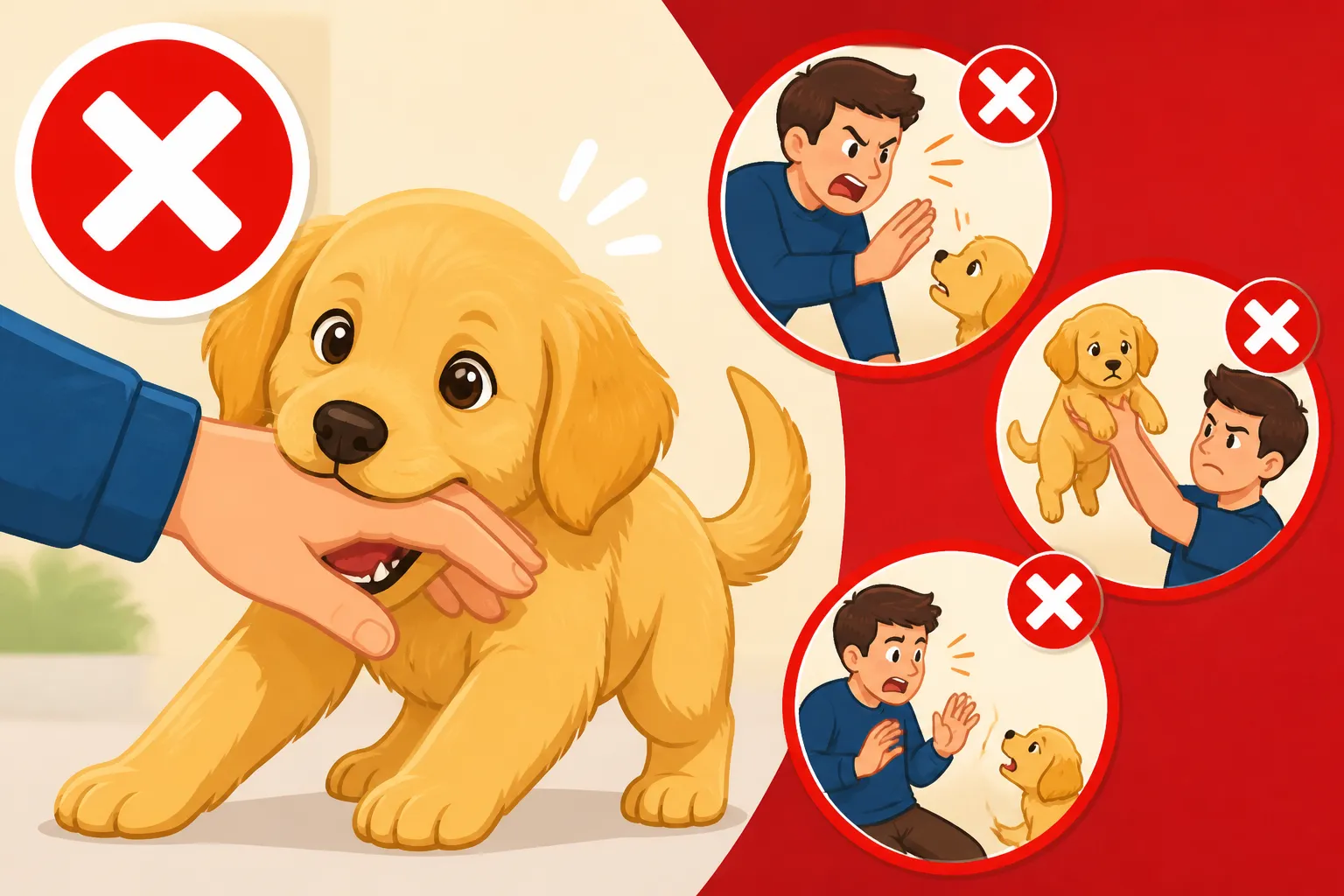
One of the most common knee-jerk reactions when a puppy bites hard is to yell "NO!" or deliver a sharp, startling sound. While it might grab their attention for a second, it's often counterproductive in the long run. First, yelling can scare your puppy, leading them to associate your hands or interaction with something negative. This fear can manifest in various ways, from shyness to an actual increase in fear-based biting later on. They might not understand why you're yelling, only that your reaction is big and startling.
Second, for some puppies, especially those with high energy or a playful nature, yelling can actually be interpreted as an invitation to continue or even intensify the game. They might see your raised voice and quick movements as part of the play, exciting them further. Instead of understanding that they've hurt you and play should stop, they think, "Oh, this is fun! My human is playing rough too!" This can quickly devolve into a chaotic cycle where the biting gets worse, not better. Remember, the goal is to teach them to be gentle, not to fear you.
Using Your Hands as Playthings
I get it, those little paws and that soft fur are irresistible, and it's so tempting to wrestle and tumble with your Golden puppy using your hands. However, this is one of the quickest ways to teach your puppy that human hands are toys meant for biting and mouthing. Every time you engage in rough play with your hands, you're sending a mixed message. You're essentially saying, "It's okay to bite hands when we're playing," but then you're surprised when they nip you during a calm petting session.
Puppies don't differentiate between "play biting" and "serious biting" in the way we do. They just know that hands are something to interact with using their mouths. By consistently using appropriate toys for play – ropes, squeaky balls, soft plushies – you clearly define what is acceptable to bite and what isn't. Your hands are for petting, feeding, and offering treats, not for wrestling. It's a simple distinction that can prevent a lot of confusion for your growing puppy. Many great, durable chew toys can be found easily online, for example, on Amazon. This strategy is key to understanding Why a Golden Retriever Puppy Bites Hands.
Inconsistent Responses to Biting
Perhaps the most frustrating mistake is inconsistency. One moment, you might let a gentle mouth on your hand slide, and the next, you're yelping loudly because the bite was a bit harder. Or maybe one family member uses a time-out strategy, while another tries to distract with a toy. This sends incredibly confusing signals to your Golden puppy. They thrive on routine and clear boundaries. If the rules keep changing, they'll struggle to understand what's expected of them.
Inconsistency teaches them that sometimes biting works, and sometimes it doesn't, leaving them to keep experimenting to find the "right" way. This often means they'll continue to bite until they stumble upon a reaction that consistently works for them, which usually means increasing the intensity until they get a response. For effective Golden Retriever Training Sessions That Are Too Long, you need consistency across all family members and all situations. Everyone in the household needs to be on the same page about how to react to puppy biting – every single time. Without this uniformity, you're prolonging the learning process and making it much harder for your puppy to develop proper bite inhibition.
Not Providing Appropriate Chew Outlets
A Golden Retriever puppy has an inherent need to chew, especially during their teething phase. If you aren't offering a variety of enticing, safe chew toys, they're simply going to find their own, and often, those choices involve your furniture, shoes, or unfortunately, your body parts. This isn't naughtiness; it's instinct. Ignoring this fundamental need is a major misstep.
Many new owners buy one or two toys and expect that to be enough. However, puppies need variety and novelty to keep them interested. Rotate toys, offer different textures (rubber, plush, dental chews), and ensure they are appropriately sized for your Golden. If your puppy is constantly seeking out your hands or other inappropriate items to chew, it's a huge sign that their chewing needs aren't being met. This oversight directly contributes to problem biting and can lead to property destruction. Make sure you have a consistent supply of good, durable chew toys readily available, so your puppy always knows what they can chew on.
What to Avoid When Your Puppy Nips Hard
When that little land shark suddenly escalates its nips from playful to painful, your immediate instinct might be to react strongly. But some common reactions can actually backfire, teaching your Golden puppy the wrong lessons or even damaging your bond.
Physical Discipline or Alpha Rolls
Let's get this out of the way: never, ever resort to physical punishment or "alpha rolls" when your Golden puppy bites. An alpha roll involves forcing your dog onto their back and holding them down, supposedly to show dominance. This outdated and harmful method is based on flawed understandings of canine behavior and pack dynamics. Dogs do not naturally "alpha roll" each other in the wild to establish dominance over misbehavior.
What this does teach your puppy is that you are unpredictable, scary, and a source of pain. It erodes trust, creates fear, and can lead to a dog who bites defensively out of fear, rather than playfully. You want your Golden to see you as a benevolent leader, a safe harbor, and a source of comfort, not as a threat. Physical corrections are not only ineffective for bite inhibition but can cause long-term behavioral issues and severely damage the loving bond you're trying to build. You're aiming for a confident, happy companion, not a cowed, fearful one.
Pulling Your Hand Away Quickly
It's a natural reflex: when something sharp pokes or bites you, you yank your hand away. However, for a Golden Retriever puppy, this quick, jerky movement can often be interpreted as part of the game. To them, it looks a lot like a fun chase or a playful wrestle. That sudden movement can actually encourage them to bite harder or to chase after your retreating hand with renewed vigor, thinking you're inviting them to a more exciting interaction.
Instead of yanking away, try to make your hand "go dead" or gently push it into their mouth for a split second. This might sound counterintuitive, but it takes away the "fun" of the chase. Their bite will often loosen as they adjust to the lack of resistance. Once they loosen their grip, you can then calmly remove your hand. This technique, coupled with an immediate withdrawal of attention (more on that in a moment), teaches them that biting results in the game stopping, not intensifying.
Ignoring Bites That Hurt
While ignoring some undesirable behaviors can be effective, completely ignoring bites that genuinely hurt is usually not the right approach for bite inhibition. Some people advocate for simply letting the puppy bite and enduring it until they stop, but this sends a dangerous message. If a bite is hard enough to cause pain, it means your puppy hasn't learned appropriate bite pressure, and continuing to allow it doesn't teach them anything about human skin's fragility.
Instead, the moment you feel a painful bite, a sharp, high-pitched "yelp" (mimicking a puppy's cry) is often effective. This is covered in more detail in Yelping Versus Ignoring a Biting Golden Puppy. Immediately after the yelp, remove your attention completely. Stand up, turn your back, or even leave the room for a few seconds (a "reverse time-out"). This teaches your puppy that hard bites result in the immediate cessation of all fun and attention. The key is that the consequence (loss of attention) must be immediate and consistent. If you just ignore it and continue playing, they'll learn that painful bites are tolerated.
It's a delicate balance: you don't want to overreact, but you also don't want to become a human chew toy. The goal is to clearly communicate that your skin is sensitive and that painful bites mean play stops.
Setting Your Golden Puppy Up for Success
Instead of focusing solely on stopping the unwanted behavior, a more effective long-term strategy involves teaching your Golden puppy what to do instead. This proactive approach, built on positive reinforcement and consistent management, will foster a well-behaved companion rather than just a puppy who doesn't bite.
The Power of Positive Redirection
Redirection is your best friend when dealing with a mouthy Golden puppy. The moment your puppy starts to mouth or nip at your hands, immediately offer them an appropriate chew toy. This could be a sturdy rubber Kong, a braided rope toy, or a plush squeaker. The key is to make the toy instantly available and more appealing than your hand. When they take the toy in their mouth, praise them calmly and enthusiastically, "Good chew!" or "Yes, that's a good toy!"
This method is powerful because it teaches your puppy a desirable alternative. Instead of just learning "don't bite hands," they learn "when I feel like biting, I should bite this toy, and I get rewarded for it." Keep a variety of toys handy in every room you spend time in, so you're always prepared to redirect. Redirecting a Golden Retriever Onto a Toy is a skill you'll use constantly in the puppy phase. For example, a subscription box with new, durable toys can be a fantastic way to ensure you always have interesting redirection tools on hand. Some owners have great success finding durable toys on Amazon that hold up to a Golden's strong jaws.
Consistent Training and Management
Effective puppy training isn't just about reacting; it's about anticipating and managing the environment to prevent problem behaviors from happening in the first place. This means being vigilant and proactive.
Structured Play & Training: Incorporate short, frequent training sessions throughout the day. Teach basic commands like "sit," "stay," and especially a solid "leave it." These commands give you tools to interrupt unwanted behaviors and redirect your puppy's attention. Keep sessions positive and fun, using high-value treats to motivate. A good online program like BAXTER & Bella can provide structured guidance for these early training steps.
Adequate Exercise & Mental Stimulation: A tired puppy is a good puppy! Golden Retrievers are energetic and intelligent. If they aren't getting enough physical exercise (appropriate for their age and growth plates, of course!) and mental stimulation, they will find their own ways to release that energy, often through destructive chewing and biting. Daily walks, supervised play in a secure yard, puzzle toys, and scent games can all help. A bored puppy is a mouthy puppy.
Nap Time is Crucial: Just like human toddlers, puppies can get "overtired" and become cranky and bitey. Ensure your Golden puppy gets plenty of undisturbed rest in their crate or a quiet designated area. Sometimes, the solution to excessive biting is simply a nap!
Socialization: Proper Socializing a Golden Retriever Puppy with other well-behaved, vaccinated dogs can also help. Other dogs will correct a puppy who bites too hard, reinforcing bite inhibition in a natural way. Always supervise these interactions carefully to ensure they are positive.
Here's a quick comparison of common reactions and their outcomes:
| Situation: Golden Puppy Bites Hard | Ineffective Response to Avoid | Why It's Bad | Effective Response to Adopt | Why It Works |
|---|---|---|---|---|
| Puppy nips your hand playfully | Wrestling hands with the puppy | Teaches hands are chew toys | Redirect to appropriate chew toy | Teaches what can be bitten; rewards good choices |
| Puppy bites hard, causing pain | Yelling "NO!" or physical punishment | Creates fear, confusion, or escalates play | Sharp "yelp," then immediate withdrawal of attention | Mimics littermate correction; removes desired attention |
| Puppy is over-excited and bitey | Continuing to play rough | Reinforces hyper-arousal and biting | Enforce a "reverse time-out" | Teaches calm behavior leads to attention/play |
| Puppy chews forbidden item | Chasing to retrieve the item | Makes it a fun game of chase, reinforces grabbing | Trade for a high-value toy/treat | Teaches "give" and that better things exist |
| Puppy constantly seeks things to chew | Not having toys readily available | Forces puppy to find inappropriate outlets | Have multiple, varied toys accessible | Meets natural chewing need proactively |
By consistently applying these effective strategies and consciously avoiding the common pitfalls, you'll guide your Golden Retriever puppy through their nippy phase much more smoothly, building a foundation for a well-mannered and cherished companion. The biting will eventually subside; most puppies will reduce their hard biting significantly by 4-5 months of age, and it generally stops by 6-7 months. Knowing When Golden Retriever Puppy Biting Stops can help you manage your expectations.
Disclaimer
This article is for general informational purposes only and does not constitute professional advice. Laws, prices and regulations vary by location and change over time. Consult a qualified professional for guidance on your specific situation.